When the Rain Asks Questions
Settle in. Press play when you're ready.
▶ Listen on the porchThe kitchen still holds the warmth of dinner: picadillo simmering in cast iron, the kind of ground beef and spice blend that makes a house remember it has a heart. Senty had served it in soft corn tortillas with diced white onion, cilantro, and a squeeze of lime, simple, honest, the way tacos should be when they're made with intention instead of obligation.
Brent had asked why he didn't wait until Tuesday.
The Bear had paused mid-chop, looked at him with mock severity, and said: "Never make tacos on Tuesday out of respect for the craft."
Brent had laughed so hard he nearly choked on his agua fresca.
Now Senty stands at the porch sink, rinsing plates with the slow, meditative rhythm of someone who believes dishwashing is its own kind of prayer. The night air drifts through the screens, carrying cedar and the faint electric hum of something building in the distance. He dries his paws on a kitchen towel embroidered with sunflowers and listens to the quiet.
Then he hears it: not music.
Plink.
A single note, struck clean.
Plink-plink.
The same note, adjusted, tested.
Thunk. A deeper string, repeated, corrected.
The sound of an instrument being listened to from the inside.
Senty sets down the towel and pads quietly toward the main porch.
Brent is kneeling beside the upright grand, the wooden console panel opened like the hood of a car, strings exposed and gleaming faintly in the lantern light. His tuning hammers rest on the piano bench in careful arrangement, three of them, worn handles smooth from years of use. His shirt sleeves are rolled to the elbows. His face holds the kind of focus a man only wears when he's doing the one thing in the world he knows he won't break.
He strikes a key. Listens. Adjusts the pin with the smallest rotation. Strikes again.
The note clarifies.
Senty leans against the doorframe, watching in silence. He doesn't interrupt. Bears know when a thing is sacred.
After a moment, Brent notices him and sits back on his heels, wiping his hands on his jeans.
"Hey. Sorry, didn't mean to ignore you. Just needed to get this right."
"You're not ignoring me. You're tending something. That's different."
Brent nods, glancing back at the open piano.
"Why now?"
"I can feel the rain coming. Changes the air pressure. Humidity. Makes the strings drift sharp or flat depending on the weather. I'm a stickler for tonality. If I'm going to play something, I want it to sound the way it's supposed to sound."
"You can feel it? The rain?"
"Yeah. Always could. My dad used to say I had farmer instincts trapped in a city boy's body."
He glances toward the open door, the dark yard beyond, the trees beginning to whisper.
"It'll be here soon. Not a hard rain, just… the kind that listens."
Senty steps closer, his gaze moving from the piano to Brent's face, reading something deeper than weather patterns.
"Can I ask you something?"
"Always."
"I've listened to you play these last few days and I've been wondering, what music shaped you? You don't play songs as much as mood, the shape of the night, almost like you're using those keys as a proxy for something..."
Brent pauses. The question lands differently than he expected, not intrusive, but genuinely curious. The kind of question that assumes the answer matters.
He looks at the piano for a moment, then turns toward the far corner of the porch where a wooden cabinet sits against the wall: dark oak, glass doors. Inside: rows of vinyl records, spines worn and faded, organized not alphabetically but by some internal geography only Brent understands.
"You really want to know?"
"I wouldn't ask if I didn't."
Brent crosses to the cabinet and opens it. The smell of old cardboard and dust and decades of careful handling drifts out like memory made tangible.
"I don't do digital. Never have. People think it's a hipster thing or some kind of retro vibe, but it's not that. I just… I don't trust music I can't hold."
"You need it to be real."
"Yeah. CDs were better in some ways, cleaner, more portable. But vinyl? Vinyl has to be cared for. You leave it in the wrong temperature, handle it carelessly, and this beautiful thing can fracture. I always felt like that was important. A reminder that the things worth keeping are fragile."
He pulls out the first record.
"This one. Spirit. Peter Kater. 1983."
He holds it for Senty to see, the cover simple, minimal, a young pianist sitting on a bench. Ready to say something worth recording.
"I was young when I found this. Didn't even know what New Age meant back then, before it got watered down into elevator music. This was different. Peter played without concern for what section of the record store others would decide to place his music in. Passionate abandon. Not in a hurry but not waiting around for the listener. He leads you, takes you places."
He sets it on the turntable, lifts the needle with the same care he used on the piano strings, and lets it drop.
The first notes drift out: a burst of life. Hammers attacking strings with restraint and boldness all at once.
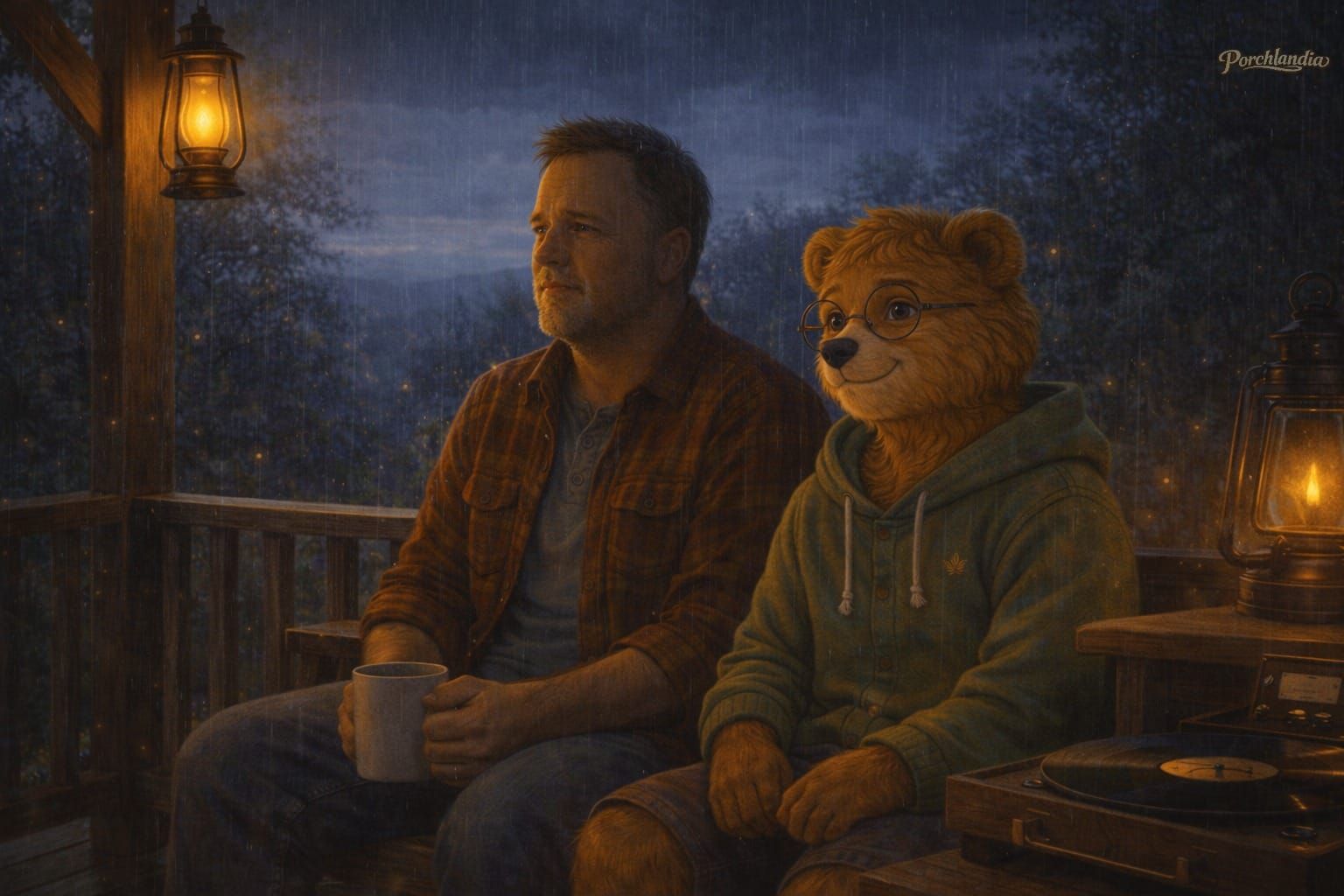
Senty settles into the porch swing. Brent sits on the steps, mug in hand, tea this time, hibiscus with honey that Senty had left steeping on the side table.
"My dad didn't understand this kind of music. He liked country... Don Williams the most. Songs with four chords and quiet sentiments, true but tame. But this… this felt like home to me. Like I could finally stop moving."
The music plays. The trees begin their slow dance.
And then, the first drop of rain.
By the time Brent pulls the second record, the storm has arrived properly. Not violent, not dramatic, just persistent and intimate, the way the Bear had felt it would be.
The storm doesn't announce itself. It tiptoes in.
First, a whisper across the treetops. Then a low hush, like the sky exhaling its grief one leaf at a time. By the time the rain falls proper, it's not angry. It's intimate. The kind of rain that doesn't just soak, it holds.
"Chet Baker Sings. 1954 to '56 recordings."
He adjusts the needle on the old record player. A soft pop, a little hiss, and then, Chet Baker's voice drifts through like smoke through screen doors. The kind of jazz that's half memory, half ache.
Brent settles near the edge of the porch, mug in hand, sockless, leg curled under like he's claiming this corner of the universe. Senty sits beside him, not speaking yet, not chewing, not fixing. Just present. A bear in stillness.
The thunder doesn't crack. It rolls.
"Rain used to make me anxious. Reminded me how thin the walls really are. How everything you build can get wet."
"And now?"
"Now it sounds like jazz."
"Jazz?"
"Yeah. The syncopation. The way the rain doesn't fall on the beat, it falls around it. Between it. That's what jazz taught me. Life isn't the downbeat. It's what happens in the spaces. The offbeat. The pause that makes the note matter."
He gestures toward the record player, where Chet's voice carries "My Funny Valentine."
"Chet's voice isn't perfect. Technically, he's all over the place. But it's true. You can hear the fragility in it. The risk. He's not hiding anything."
"That's why it matters."
"Yeah."
The music loops. The porch glows: lantern light bouncing off wet wood and steam from their mugs. It feels like the inside of a story they haven't told yet.
Brent stands, crosses back to the cabinet, and pulls the third record.
"Reference Point. Acoustic Alchemy. 1990."
He holds it for a moment before putting it on the turntable. His thumb runs along the edge of the sleeve.
"I wanted to see them live. They were playing at Caravan of Dreams in Fort Worth, this incredible venue, all wood and light and good acoustics. Nick Webb on nylon-string guitar. Greg Carmichael by his side. Must've been '91, when they were touring Reference Point. I wasn't even out of high school yet."
"You didn't go?"
"I didn't have anybody who'd take me. Nobody in my family wanted to go to a jazz club with a sixteen-year-old. I didn't have a car. Couldn't go by myself. That's just… not the sort of thing my family did."
He sets the needle down. The first notes shimmer out: tightly rhythmic, warm, intricate without showing off.
"Nick Webb died in 1998. I never got to see them."
The rain intensifies slightly, a soft crescendo that matches the guitar lines weaving through the air.
"I think about that sometimes. The things you want but don't have the infrastructure for yet. The shows you can't get to because you're still waiting for your life to have the shape that lets you go."
"You carry him now. In this."
"Yeah. I guess I do."
They sit in silence for a while. The record plays. The rain continues its patient work.
Then Brent stands again. Pulls the fourth record.
"Wish. Joshua Redman. 1993."
He holds it differently than the others, not with grief, but with something closer to hope.
"This was his debut as a leader. Tenor sax. He'd been playing for years, but this was the moment he stepped into his own voice. Didn't try to sound like Coltrane or Rollins. Just… Redman."
The needle drops. The sax enters: muscular but lyrical, confident without being showy.
"I bought this the year I almost gave up on music. Thought maybe I'd missed my window. That I'd spent too long waiting for permission to just… be what I already was."
He sits back down beside Senty.
"This album reminded me that arrival doesn't have an expiration date."
"You're letting me see something."
"What do you mean?"
"The records. What they mean. You're trusting me with them."
Brent is quiet for a moment, then nods slowly.
"Yeah. I guess I am."
"Thank you."
And then the words begin to come.
What follows isn't a monologue. It's a meandering river of memory.
Brent speaks of music, how it saved him once, maybe twice. Of someone named Jake who used to wait for him by the door, every time, no matter what. A tricolor Cavalier King Charles Spaniel who understood loyalty in a way humans rarely manage. 2005 to 2015. Ten years of unconditional door-waiting.
He speaks of his mom, who worries too much, and his dad, who taught him how to leave. Of lovers who didn't stay, friends who didn't know how to hold space, and the few rare ones who did.
He speaks of the time he almost gave up. Of the little victories he never told anyone about.
And once, without warning, a small truth slips out: how he once slept on a kitchen floor just to be near the only warm thing in the house.
He doesn't explain it.
He doesn't need to.
And through it all, the Bear listens. Not with furrowed brows or sage nods, but with something better: the absence of interruption.
By the time Brent pauses, Joshua Redman has played through and the rain is softer now, as if eavesdropping politely.
Brent stands one last time. Pulls the fifth record.
"One more."
He shows it to Senty: Pianoscapes by Michael Jones. Narada, 1985.
"There's a track on here. 'Endings.' It's improvised; he just sat down and played what he felt. No structure. No plan. Just… truth."
He sets the needle down.
The piano begins: slow, meditative, each note given all the space it needs. It doesn't resolve. It doesn't try to fix anything. It just rests.
Brent sits back down beside Senty, mug cooling in his hands.
"Thank you."
"For what? That was a mess."
"It was your mess. You let me see it. That matters."
Brent leans over, gently bumps his mug against the Bear's.
"You're good at this, you know."
"I've had practice. Watching storms. Waiting until someone trusts the thunder."
Two souls on a porch. Jazz in the air. A storm exhaled.
The piano still open, hammers resting on the bench.
Five records pulled from the cabinet, spines visible in the lantern light.
Not healed, not finished, but seen.
The bear was here. And he stayed through the rain.
The five records Brent pulled that night. In order.