That Scanned
Settle in. Press play when you're ready.
▶ Listen on the porchThe house was still dark when Senty finished writing.
He folded the page before the ink had entirely dried and slid it into a flat envelope addressed to Byron McTavish. Four initials went in the return corner.
S. S. M. B.
Beside it waited a clean cloth bundle tied once. The smaller note took less time.
He walked to the road in the dark with the bundle beneath one arm and the envelopes held flat against his chest. The drive was long enough that the porch light would have been small behind him if it had been on. It was not.
At the B. BROOKS box, he put them in together, closed the door and raised the flag. He stood for a moment with one paw on the cold metal.
Then he walked back.
The fountain was dry.
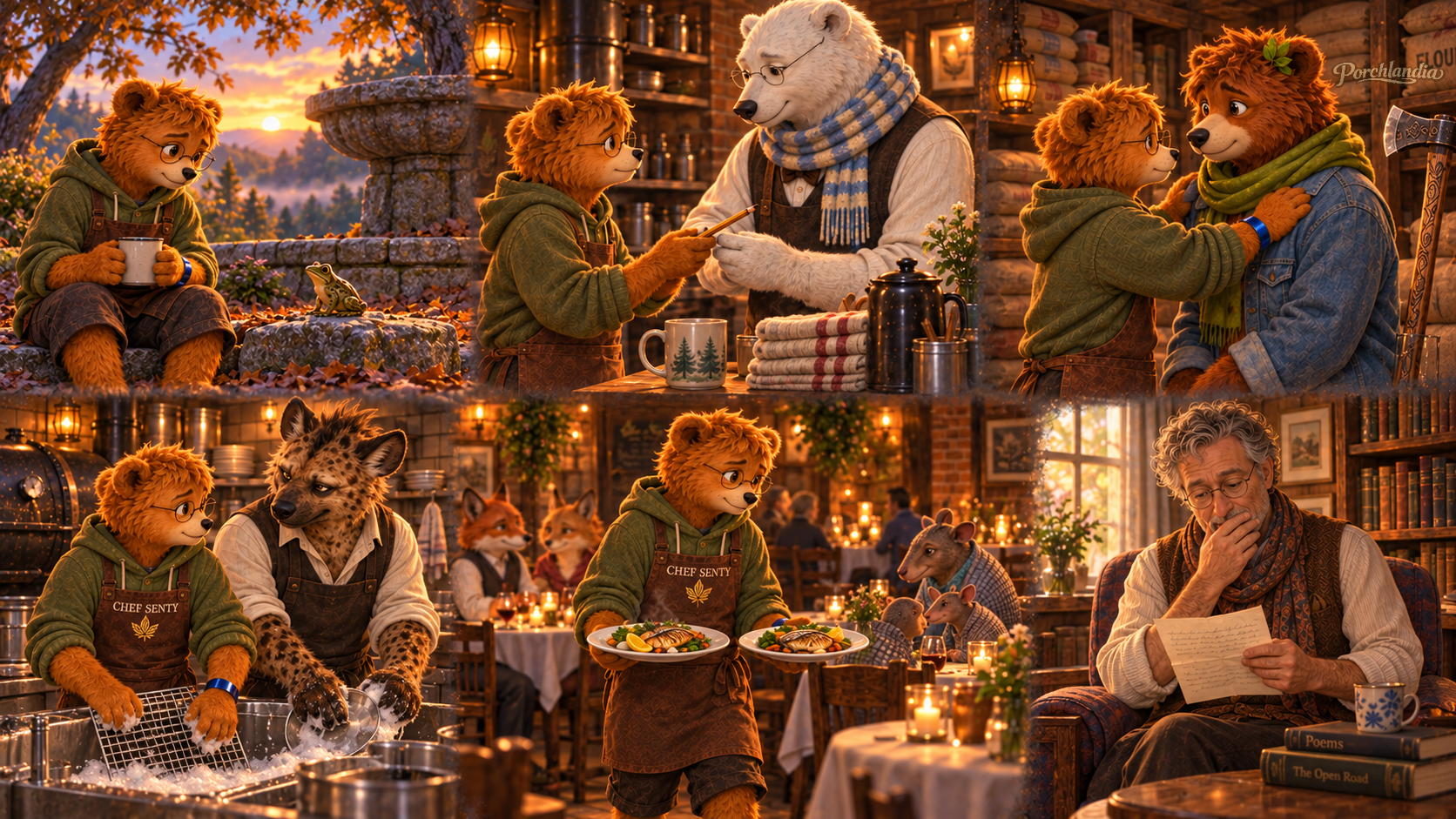
Senty sat on the broad stone with his mug and did not drink from it. The pond was still. The koi hung beneath the water. Milton was on his stone across from him, and Senty looked at him, and the frog looked back, and neither said anything for as long as it took the stars nearest the pecans to go out.
When the first gray reached the trees, Senty stood.
"I'm going to go see about the water," he said.
Milton stayed on the stone.
That was the whole of it. Milton had never offered him an interpretation. Senty was not going to ask for one at the end.
Clement was folding towels when Senty entered the kitchen with the empty mug.
Senty did not write the prep list.
He warmed the pot instead. He measured the Darjeeling and poured widdershins, which he had watched Clement do for as long as there had been a Clement in this kitchen and had never done himself because it was not his to do.
He carried the cup to the tea station and set it at Clement's elbow.
Clement looked at the cup. Then he looked at Senty.
Senty took the pencil from behind his ear and held it out. Not the list. The pencil.
Clement took it, turned it once in his paw and put it behind his own ear, where it had never been.
"I know."
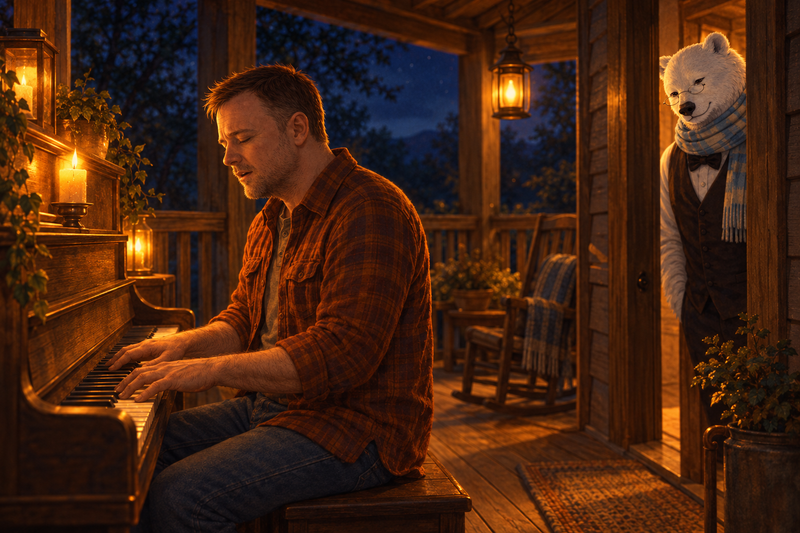
Across the dining room, Brent raised the piano lid. He was wearing yesterday's shirt and carrying his first coffee. When he saw Senty at the tea station, he touched two fingers to the side of the cup.
Senty returned the gesture.
The hardest goodbye could wait until the others were safely given.
The first chord entered the kitchen while Senty put the brisket on at five. Clement drank the tea, and it tasted like tea.
Glorp was in the storage room with the door half shut, suiting up.
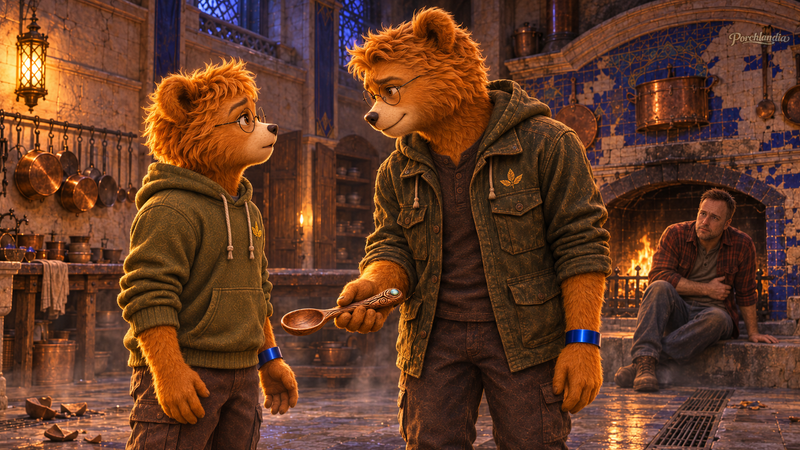
Senty watched from the doorway before his cousin noticed him. There was a heavy dark coat Senty had never seen, buttoned wrong. There was a satchel. There were boots, which was the first time in the life of the porch that Senty had seen Glorp consider footwear. Leaning against the flour sacks stood an axe whose handle was carved with small climbing figures. Their journey became less sensible the farther it traveled toward the head.
"Cousin, where did you get an axe?"
Glorp looked at it. "It is ceremonial."
"That was not the question."
"It was a gift from the monks I learned from."
Senty looked at the axe again. "There were monks."
"Many."
"And they gave you that."
"After the horse."
Glorp said it with no more embroidery than Brad might have used to report a clogged drain. For the first time, Senty understood that his cousin's stories might not have grown in the telling. They might have arrived that size.
"You are not coming," Senty said.
Glorp stopped with one boot on. "I am extremely strong."
"You are. I need the strongest thing in this house between that wall and the porch."
Glorp looked toward the rear service aisle. "Does the yellow line still count?"
"It counts."
Glorp nodded and took off the boot. He accepted the instruction as he had accepted Brad's rules: completely, and with the face of a scout being told his mission was the yard.
Senty came into the room and put both paws on his cousin's shoulders.
"When I get back, tell me about the horse. All of it."
"It is a long story."
"Then I will need to come back with time."
Glorp's mouth moved. The grin did not quite arrive, but enough of it did.
"All of it is true," he said. "That was always the problem."
Brad looked up from the smoker's open belly with a wire brush in his paw when Senty entered the pit.
Senty did not explain. He picked up a rack from the dirty side, carried it to the sink and began to wash it.
Brad watched him for a while. "You don't do that."
"No."
"You've never done that."
"No."
The rack came out of the water with a smear beneath one corner. Senty's paws were made for dough, not steel. Brad took it, rinsed the smear himself without comment and put it in the clean rack.
"The bay is yours," Senty said to the sink. "The fire. The chocks. Rule four."
Brad returned the brush to the smoker. "I know how the smoker works."
"You'll know the meat is right by the smell. You always did. You knew before I did, most days. You just didn't say."
Brad kept brushing. "Rule four's not going to be a problem with you on the other side of it."
"No. I suppose it isn't."
They worked. The water ran. Behind them, Clement's cups touched their saucers, Glorp's axe bumped one doorframe and then another, and Brent tried a phrase at the piano before abandoning it for a better one.
After a while, Brad set down the brush and stood beside Senty with both paws in the water, washing nothing.
"Bring it back with smoke in it," he said.
"I will do everything I can."
That was as far as either could go, and it was far enough.
Lunch arrived hungry.
The possums took the table beneath the front window. Three cardinals occupied four chairs and conducted an argument about seed that survived every course. The armadillo family ordered as a unit and changed its mind by individual. Smoke & Soul received them all.
Senty moved from table to table and gave the room exactly what it asked for. He refilled the possums' rolls before they noticed the basket was empty. He put the cardinals' sauce on the side without making anyone admit whose idea it had been. He sent the smallest armadillo an extra hand pie because the child had spent most of lunch giving pieces of his first one away.
Brent played through the service. Senty saw him at the piano as he crossed the dining room. He saw him again when the room laughed at something Glorp had said near the bar. Once, Brent came through the kitchen for coffee and stood beside him while Senty finished a plate. Their shoulders touched. Neither spoke.
Brent was there.
Senty was saving him.
At the two-top near the stairs, Percival Finch and Constance had ordered trout. Senty carried their plates himself and set them down.
"The conversation you came to have," he said. "Have it."
Percival looked at Constance. She had already placed her paw on the table between them.
"We intend to," she said.
Senty turned to go, then stopped beside Percival.
"You heard them before you knew why. Keep doing that."
Percival's paw rose toward the brim of his bowler and stopped there. Senty went back to the pass.
Behind him, for the first time in a great many lunches, Percival said something to his wife that made her put down her fork and listen.
Teddy stayed after the dining room emptied.
He sat in his usual chair with his cane against one knee and Otis moving quietly behind his closed mouth. Senty came out carrying the saxophone case and took the chair beside him.
"You aren't playing," Teddy said.
"Not today."
"No."
Senty rested both paws on the case. "I wanted to thank you."
"For requiring accompaniment?"
"For being afraid in public. It was useful."
Teddy opened his eyes. "I did not do it for instructional purposes."
"Most useful things are done for another reason."
From the kitchen came the sound of Brad correcting Glorp's pan order. The correction ended. A pan moved.
Teddy looked at the case beneath Senty's paws.
"You're coming back to play it again," he said.
It was not a question.
"I intend to."
"Good. The second time is different."
"Better?"
"Different. Better is greedy."
Teddy rose with the assistance of the cane and Senty's forearm. He adjusted his waistcoat.
"Thank you for the accompaniment," Senty said.
The old otter considered the theft and allowed it.
"We both arrived," he said.
He went out along the road humming.
Marty's board still held the zero.
The ferret lay beneath his scarf with one eye open. The Featherfoxes slept together in their basket at the foot of the chaise. Loose silver-gray feathers gathered around them.
Senty sat on the floor beside Marty.
"I would like the odds of my coming back."
Marty closed the open eye.
"That is traditionally when you write a number," Senty said.
"No."
"No odds?"
"No number."
Senty looked at the zero on the board. "Because the room is still wrong?"
Marty pulled the scarf higher beneath his chin. "You'll come back."
"Is that odds?"
"It's not odds. It's just true."
Senty waited for the ferret to retreat from the sentence. Marty did not.
"Thank you, Martingale."
Marty opened both eyes.
Senty smiled.
He stood, carried the Featherfoxes' basket to the pass and set it down. Lunch's last plate had gone out. The apron came off.
Senty smoothed it once against the counter. Flour had found the lower pocket. A dark crescent of sauce marked one tie. Smoke had settled into the cloth so completely that no washing had ever removed it.
He hung it on its hook. Then he carried the Featherfoxes upstairs to sleep.
When he turned at the kitchen door, both of Marty's eyes were open. They stayed on him until he was gone.
Senty came back down to look for Brent. Clement was at the tea station. Brad and Glorp worked the return lane together. Brent had closed the piano sometime during the last seating, though Senty had seen him near the side door afterward with a ring of keys in one hand.
There had been time all day.
Senty had saved the hardest goodbye because Brent deserved more than something squeezed between a trout and a refill. He deserved the porch after closing. Two chairs. No work left that could pretend to be urgent.
Senty went upstairs again. The Featherfoxes had woken in their basket. All three stood with their faces lifted toward the floor.
The smallest climbed over the rim.
The others followed.
They moved down the hall, stopped at the stairs and looked back.
"I know," Senty said. "Soon."
The nearest fox crossed the hall and pressed its nose to the gray edge of his wristlet.
"Now."
The word entered him colder than the morning coffee.
"I have one more."
The Featherfox turned toward the stairs.
Senty went to the piano first.
The lid was down. The bench stood square beneath it. Brent's coffee cup had left a ring on the coaster and nothing else.
"Brent?"
He crossed the dining room and took the stairs two at a time. The porch step where Brent had sat beside him the night before was bare. The Chet Baker record rested in its sleeve. One chair stood slightly away from the wall, but no one occupied it.
Brent's bedroom door was open. The bed had not been turned down. His old shoes were beneath the chair and the shirt from that morning lay over its back.
"Brent."
Senty checked the upstairs kitchen, though he knew Brent was not there. He went back through the hall, out to the porch, around the trellis and far enough into the yard to see the dark shape of the garage. No light showed beneath its door.
The Featherfoxes had followed as far as the steps. They stood together, facing the house.
Senty understood what he had done.
He had spent the day placing goodbyes carefully into every hand except the one he could not imagine releasing. Brent had been at the piano. Brent had come for coffee. Brent's shoulder had touched his at the pass. Senty had trusted there would be one more room, one more hour, one more chance to tell his zest friand what every smaller goodbye had been practicing.
The chance had gone somewhere he could not find it.
"Please," Senty said. He did not know whether he meant Brent, the foxes or the part of the house that had once answered him with water.
The smallest Featherfox ran toward the service door.
From beneath the porch came a low change in the air.
The Door was opening.
Senty went down to Smoke & Soul.
He did not want to. The Featherfoxes kept moving and he followed because the road belonged to them. They had crossed it, found him and remained while their feathers fell away. He did not know how to call the Door, hold it or choose where it went. His decision had been his own. The hour had not.
In the smoke bay, the smoker stood forward on its rails.
Glorp waited at the yellow line with the ceremonial axe upright in both paws. Brad stood beside the pit. Clement held the mouth of the aisle. Marty sat on the concrete beside a cup that had long since stopped steaming.
The circle in the wall contained a road beneath two moons.
The Featherfoxes went to work.
One ran clockwise around the fused brick, touching every fourth place where cobalt showed beneath the glaze. A second moved the other direction, pausing with one paw against ember-colored fractures that appeared only when it found them. The smallest stood at the bottom and whispered sounds too quick for Senty to hold. With each sound, another portion of the distant road came into view.
They were not opening the Door. They were illuminating the road already there.
Senty stopped behind the yellow line.
Brent was not there.
The panic returned larger. It pushed against his ribs until the road in the wall narrowed.
"I can't," he said.
Brad looked at him. "Can't what?"
"I didn't find him."
"Find who?"
"Brent."
Brad's face changed. He looked toward Clement.
Clement shook his head once.
No one knew.
The Featherfox at the bottom of the circle whispered, "Now."
Senty looked at the road. "I am not leaving without saying goodbye."
"Then don't," Brent said.
He stepped around the far corner of the smoke bay wearing an old green hiking backpack.
It rode too high on his shoulders and had been packed by someone who believed preparedness could be achieved through volume. A flashlight hung from one strap. A rolled blanket occupied the top. Two canteens rode the sides beside a first-aid kit, a coil of rope and a small hunting knife secured in a leather sheath. The bottom of the pack had been broadened by several wrapped containers whose smell reached Senty before Brent did.
Brisket.
For one second Senty could not move.
Relief reached him first. Anger came behind it carrying several reasonable points and no command of language.
"You are wearing a backpack," he said.
"That's what these are generally for."
"There is a knife on it."
"It was in the garage."
"Do you know how to use it?"
"I know which end not to hold."
Brad made a sound into one paw.
Senty looked at the flashlight, the rope, the canteens, the old blanket and the pack sitting badly on the frame of a man whose wilderness experience had mostly involved outdoor music festivals with marked exits.
"What are you doing?"
"Coming with you."
"No."
"Okay."
"That does not mean what it meant when you said it on the porch."
"No. This one means I heard you and I'm still coming."
"You cannot."
"I can. I found socks."
"Brent."
The joke left his face.
"The night of the HOA," Brent said. "When I thought that stuffy room with all its procedures and rules was going to slam this place shut with a gavel. You showed up for me. You stood in the way, and you changed where things were headed." He shifted the pack. "Why would I do any less for you?"
Senty looked at the pack, and at the man, and at the road.
"Brent. That's... kind. I understand what you mean when you say that, and it's very you." He stopped. He tried again, and his voice had gone lower. "But as the memories have been coming through whatever fog this journey gave me, I know enough to know you shouldn't go. You can't. My world isn't like yours. It's sick, somehow. It's unstable. It is not safe."
"I know."
"You don't."
Brent adjusted one strap. The flashlight knocked lightly against his chest.
"No, I mean I heard you," he said. "That room was paperwork. Nobody was going to get hurt in a folding chair. You're telling me this is the real thing and that was practice."
"Yes."
"Then what was I standing next to you for? If I only show up when it's safe to show up, I didn't show up for you. I showed up for me."
Senty looked through the circle. The two moons hung where memory had left them. Somewhere beyond the black hill, a kitchen hearth had gone cold.
"Someone was afraid for me," he said. "I remember that much. I know what it costs now. I'm asking you not to make me be that for you."
Brent came close enough to place one hand on his shoulder.
The touch carried no memory with it. Only the hand that was there.
"Where you go, I go," Brent said. "The bond is only real if it travels."
Senty lowered his head.
Brent's hand remained.
"Also, I packed food."
"I can smell it."
"Then let's go while the brisket is still warm, Senty Sterling Martindale Brooks."
Senty laughed once, and the sound broke where it came out.
"Brentusha. I am not going to be able to talk you out of this terrible idea, am I."
"Not a chance, saxophone Bear."
Behind them, Brad turned his face toward the smoker. Glorp tightened both paws on the axe. Clement's eyes rested on the pack as if he had known one thing was missing from the room and had only now learned its shape.
All day, while Senty moved through the house's people, Brent had moved through its edges—the garage, the shed, the pantry, the back of closets. They had crossed paths at the piano, over coffee and beside the pass, Senty believing the whole day that only one of them was preparing to go.
Senty looked at the backpack again.
Brent had packed for a place he could not imagine because Senty was going there.
That was the whole plan.
The Featherfoxes completed their circuit.
The road inside the wall sharpened. Dry air entered the smoke bay carrying stone, distant bread and something green crushed beneath a paw.
The smallest fox crossed first. The other two followed, silver-gray bodies passing beneath the two moons until the road took them into its dark.
Brent lifted the pack once at the shoulders. Brad came forward and tightened the loose right strap without asking.
"That's going to pull," he said.
"Thanks."
Glorp stood on the clean side of the yellow line, axe raised.
"The porch will be here," he told Senty.
"I know."
Clement touched the pencil in his apron pocket.
Marty watched from the floor.
Brent stepped to the rim and held out one hand.
"We go together," he said.
Senty took it.
"We stay together."
Brent crossed.
For an instant, the old green backpack filled the circle. Then the road received him, flashlight, knife, brisket and all.
Senty put one paw against the glassed brick.
The porch was above him. The kitchen was behind him. Every goodbye he had given remained on this side, held in a frog, a pencil, an axe, a clean plate, a song, a ferret and the ordinary hunger of tomorrow's tables.
He went through.
His paw was the last thing in the room.
Then there was brick.
For a long time, nobody moved.
Glorp did not lower the axe.
Brad stood with one hand on the smoker rail. Marty remained beside the cold cup. At the mouth of the aisle, Clement drew the pencil from his apron.
He went to the pass and clipped a fresh sheet to the board where the prep list went.
Brisket on at five. Pears for the hand pies. Onions, more than yesterday. Check the cobbler crock, which was a note to Glorp written for everyone.
At the bottom, where four initials had appeared every morning since the naming night, Clement wrote one letter.
C.
Above them, the porch held two empty chairs.
Gary Beacher found it at the B. BROOKS box the next morning.
He had not carried this route in a month. He was carrying it today because somebody upstream had a doctor's appointment. The flag was up, and inside the box there was a cloth bundle tied once and a flat envelope with his name on it.
Gary knew the bundle before he touched it. Four biscuits, wrapped in clean cloth, tied once. He had eaten one leaning against his truck at a turnaround a month ago. It had been the impossible kind.
He sat behind the wheel before opening the envelope.
Gary,
Please carry this to Byron's home. I trust you know the route.
The biscuits are for the route.
Gary read it twice.
The inner envelope was addressed to someone else. He did not open it. He set the cloth bundle in the passenger seat and put the truck in gear.
The turn onto Byron's street was not a detour anymore. It was on the route.
Byron McTavish had a slim book of verse open on his knee when the truck stopped outside.
The mail did not come at this hour. It did not come to the door. He watched a man in uniform walk up with the bundle held where anyone could see it and knock.
Gary handed it to him without a word, touched two fingers to the brim of a cap he was not wearing and returned to the truck.
Byron looked at the four initials in the return corner. By the time he looked up, Gary was already halfway down the path.
Four biscuits rested inside the cloth.
Byron sat down and placed the book face down on the arm of the chair, which he never did.
He read the letter once without sound. Then he returned to the beginning and read it aloud to the empty room.
I have listened, McTavish, since the night of the trout,
when you ordered the sea and I worked the sea out.
You wanted the bread that had listened to flame.
I have listened to you. I have learned you by name.
There's a road in the wall where the smoke used to climb,
and a hearth at the end that has run out of time.
I was sent from it once. Now it's calling me back,
and my brisket came off of the fire in black
with no smoke in the meat, and I knew by the taste
that the keeping I'd meant was a keeping misplaced.
So order the trout with two fingers, then one,
and wait for the bear who'll come back when it's done.
I have fought for these lines. They were never for free.
You will know by the cost that they came here from me.
Byron held the page by its edges.
The meter belonged to him. The trout, the sea, the bread, the wall, the smoke and the keeping did not. One word opened onto a weight he could hear and could not name.
He folded the letter along its first crease.
"That scanned."