The Entropy of Staying
Settle in. Press play when you're ready.
▶ Listen on the porchThe fountain was running when Senty came out at four.
It had been running since his first days on the porch, when the turtle's rusted mouth had found its voice again for reasons nobody had examined. Every morning since, he had drunk his first coffee to that sound. Milton waited on his stone, and the koi drifted beneath the dark water.
Senty sat with his mug between his paws.
“They came through the wall. Three of them. I said no.”
Milton ribbited.
“I heard myself say it. Brent said he was glad.”
Milton had no opinion about Brent's gladness that he was prepared to share.
“There’s another piece now. The corridor—the warm one. I told you I could smell bread there.” Senty watched the fountain. “This morning I remembered why the stones were warm. There was an oven beneath them. The bread was still there, but the fire was out.”
He took a drink before continuing.
“I don't know why that frightens me. It's only an oven. Fires go out.”
Milton croaked, once.
“No. I'm not going to tell him about the oven either.”
The frog moved on his stone.
“Not yet,” Senty amended.
He stayed until the stars nearest the pecans went out. Then he carried his mug into the kitchen, where Brent was already waiting beside a fresh pot.
Yesterday's mug stood by the sink. Brent had washed it.
“You’re up early,” Senty said.
“So are you. Again.”
Senty reached for the coffee.
“How long have the memories been coming back?”
His paw stopped at the handle. Brent had watched him sway beside the impossible wall. He had heard Senty name a world before Senty could explain knowing it.
“A few mornings. Mostly little things.”
“And you didn’t tell me.”
“I didn’t want to put something on you that I couldn’t explain.”
Brent set the clean mug beside Senty's.
“You don’t have to know what something means before you tell me it’s happening.”
“I know. I just thought—” Senty poured carefully. “You have enough to worry about. I wanted to bring you something better than a corridor with half the lights missing.”
“I can listen to half a corridor.”
“Milton has found my explanations sufficient.”
“Milton is the frog.”
Senty looked up. “You know about Milton?”
“You leave at the same time every morning with coffee and come back with mud on your cuffs. I thought maybe you’d joined Glorp’s raccoon barbershop quartet out in the woods, but something tells me you’re staying much closer. And quieter.”
From the yard came one low ribbit.
“He has excellent hearing,” Senty said.
Brent smiled, but the smile did not settle what he had come downstairs to say.
“You could have let me sit with you.”
Senty looked at the two mugs.
“I thought I was keeping it off your shoulders.”
“I know you did.” Brent leaned against the counter. “But I was upstairs wondering what you were carrying by yourself. That wasn’t much easier.”
The bear ran his thumb along the handle. Upstairs, three exhausted Featherfoxes slept in a laundry basket. He had heard them stir when he passed his bedroom, and had been relieved they were still sleeping.
“I don’t know where to begin.”
“You can begin badly. I do it all the time.”
Senty let out a small laugh.
Brent poured his coffee and stayed. For a while Senty described the warm stones, and Brent listened without asking him to decide what they meant.
Marty was back on the chaise when Brad reached the Nook.
His green scarf lay beneath his chin. Three pieces were gone from the popcorn dish, and two ordinary lines had appeared on the board: rain by four at thirty percent and Glorp dropping something he had been told to carry at seventy-one.
Brad stopped with the bus tub against his hip. His shoulders came down.
“Morning, Martindale.”
One eye opened halfway.
“Martingale.”
“That’s what I said.”
“It isn’t. Martindale is the bear. I’m the other one.”
“There’s one letter in it.”
“There’s a whole family in it.”
The eye closed. Brad carried his tub toward the pit.
The smoker stood forward on its rails, leaving the impossible opening uncovered. Brick and mortar had fused into a dark, glassy rim, with fine traces of cobalt and ember caught beneath its surface. Inside it, a few yards of dirt road led into night. Cool air came through steadily enough to stir a towel hanging from the smoker's handle.
Brad had scrubbed that wall. He knew what ought to have been behind it. Now he could stand in his own kitchen and feel weather from somewhere else.
He had made rules for the smoke bay. They were written on the back of the contest flyer in a hard forward slant and taped to the hood.
One: nobody touches the wall.
Two: nobody moves the chocks.
Three: foxes stay this side of the yellow line.
Four: nobody goes near the Chrono Door.
There had not been a yellow line the previous evening. Brad had found paint.
Glorp read the rules twice, then moved a crate that partly obstructed the aisle.
“These are good rules.”
Brad looked up from the rail lock.
“You’re not going to argue?”
“About the yellow line? No. I think you should make it wider.”
Brad set the brush across the paint can.
“I sat up with it all night,” he said. “I kept telling myself it was a picture. Paint and bad light. Then around three I put my paw up close, and there’s wind, Glorp. Wind coming out of a wall. And it smells like trees. I know trees. I’ve burned most of them. I have never burned those.”
Glorp looked toward the dark rim behind the smoker.
“Did you touch it?”
“No. I threw a pan at it.”
Glorp turned back.
“The old roaster with the handle snapped off. I wanted to hear it hit brick.”
“And did it?”
“It went in. A second later I heard it land on dirt. Farther back than this building goes.” Brad rubbed one eye. “I stood here waiting for something to throw it back.”
Glorp moved the crate another few inches.
“Nothing did,” Brad added. “That didn’t help.”
“I would have stayed with you.”
“I didn’t think I needed company. I thought I needed to find the trick.”
Glorp stood beside him. Neither went nearer the wall.
“It’s the most amazing thing I’ve ever seen, and I hate it,” Brad said. “So I made rules. For once they aren’t about the pans.”
Glorp read the fourth rule again.
“You called it a Chrono Door before anything came out of it,” Brad said. “That's why I wrote the name down. I don't need you to tell me it's a way through. I need to know what else can come through it.”
Glorp looked toward the road.
“I don't know, Brad. I remember the shape. I remember being on a road like that. Not enough to tell you who's at the other end.”
“I thought you knew. Last night, when you made me go upstairs.”
“I knew I needed to stand in front of it. I didn't know what might come after the foxes.” Glorp rested one paw on the crate. “I want to tell you we're safe. I can't promise you that.”
Brad looked past Glorp and into the opening. The cool air had reached the yellow paint. He put the lid on the can so it would not dry out.
Brad had watched him face it the night before, broad shoulders blocking the aisle. It had been easy to mistake strength for certainty.
“I’ve never seen you scared before, Glorp.”
“I usually talk more when I am.”
“Well, that explains a lot.”
Glorp tried to smile and did not quite manage it.
“I don’t want something getting past me.”
Brad picked up the brush.
“If you’re going to stand here all day, I’ll bring you a chair.”
“I would break your chair.”
“Then I’ll bring you two.”
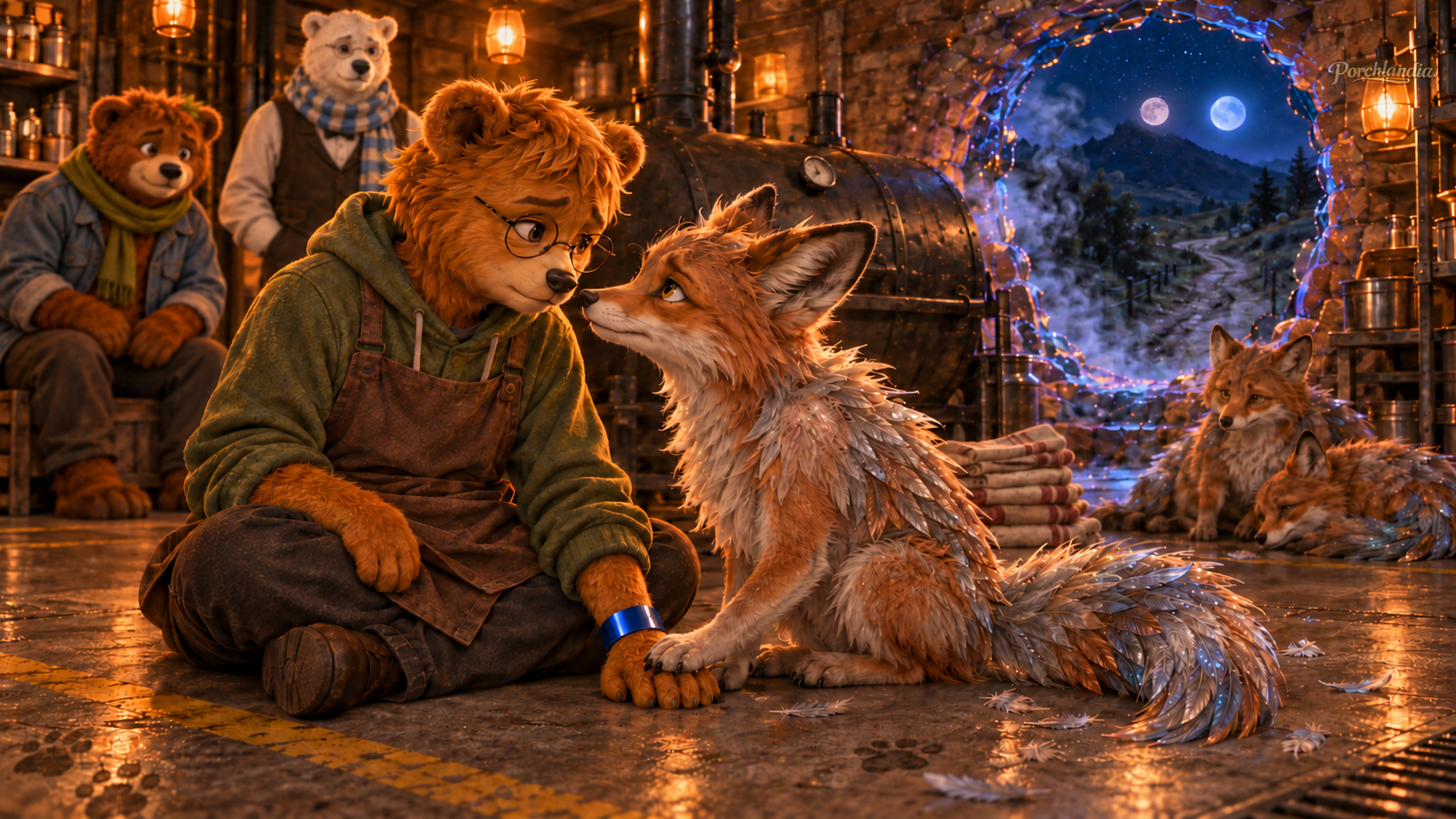
Before either could examine the offer, Senty arrived with the Featherfoxes following on their own paws. All three stopped at the yellow line, considered it, and crossed together. The smallest sat on Brad’s boot.
“That is a courtesy warning,” Brad told it.
“I don’t think the rules can apply to these little guys,” Glorp said.
“They can. They just apparently won’t.”
Brad sighed and pointed toward the prep table.
“Feed them somewhere outside my jurisdiction, please.”
Senty prepared eggs, pears and a small portion of brisket left from the night before. The foxes accepted all three, though they approached the pears as a procedural requirement rather than food. Glorp watched closely and announced each preference for a record nobody had asked him to keep.
The morning filled around the work of caring for guests. Senty found a shallow dish for water. Clement folded three small squares of cloth for bedding. Brad repaired the yellow line where one fox had sat in the paint, leaving a perfect set of prints on the clean side.
Whatever the opening in the wall might be, there were hungry creatures in the kitchen. The family could begin with those.
Clement poured the first pot of Darjeeling widdershins. The water had boiled, the tin was fresh and the leaves opened properly. He gave the pot its usual time and tasted the cup.
Then he tasted it again.
His expression barely changed. The cup stayed beneath his nose one breath too long, and one paw settled over the saucer as if to steady it. Senty had watched him taste enough tea to know that something was badly wrong.
“Clement—is there something wrong with the Darjeeling? A bad leaf in the tin?”
“The leaves are fresh. I checked.”
“Well, then, is it the water?”
“Try it before we put the leaves in,” Clement said.
He tipped the kettle into a second cup and offered it to him. Senty tasted hot water, perfectly ordinary. There was no bitterness, no odd taste from the kettle.
“The water's all right. Let me try the tea.”
Clement handed him the first cup.
It was warm and brown. Senty could find the beginning of the flavor if he looked for it, but it disappeared before becoming anything he knew how to name.
“Like somebody faintly remembers tea,” Clement said.
Senty took another sip.
“Let's make another pot,” Senty said. “I'll taste it with you.”
Clement emptied the first and began again. Senty returned to the prep counter while it steeped, but when Clement reached for the cup, he put down his knife and came back.
They tasted the second pot together. Clement had measured everything exactly. Senty could still find only the faint beginning of Darjeeling, gone before he could follow it.
Neither finished the cup.
Percival Finch and Constance arrived after lunch.
Constance took their usual table. Percival entered the smoke bay and crouched on the clean side of Brad’s yellow line. The Featherfoxes emerged from beneath the prep counter before he called them.
Their whispers began in turns. Senty heard familiar words—hearth, keeping, sent—surrounded by sounds that would not hold. Percival listened with his head tilted and his tail stretched motionless behind him.
“Do they make any more sense today?” Senty asked.
“A little. Each of them has a piece of the same sentence. They’re trying to put it back together.”
“They came to ask me to return,” Senty said. “I answered, but they keep trying to tell me something.”
The second Featherfox whispered. Percival held up one paw, asking for time, and listened until it stopped.
“They heard you. That much is clear.”
“Then why are they still here? The road is right there.”
Wind moved through the opening and lifted the loose feathers beside the yellow line. The nearest fox came closer to Percival's outstretched paw instead of turning toward the rim.
“I can't tell you why they haven't gone,” he said. “But I gave you the part I understood last night, and you answered that. There was more.”
Senty crouched beside him.
Percival turned toward the third fox. Its whisper reached the shape of a question and broke. He waited through a second attempt.
“Return was the first part I could recover. Now I can hear what it's attached to. They're asking whether the one who was sent will answer the hearth that sent him.”
Senty watched the fox try again.
“I still don't know who sent me. Or what I'm supposed to answer.”
“I know. I can hear the question, Senty. I don't have the story behind it.”
The bear rested one paw on the floor. From here he could see the pass, the towels Clement had folded and Brad's careful line across the concrete.
“I told them no because I thought they were asking me to leave all this. I don't even know what I'd be leaving it for.”
Percival let the next whisper finish before he replied.
“You needed more than I could give you last night. I'm sorry.”
The third fox pressed closer to Senty. He stroked its back, and it quieted beneath his paw.
“I don't want them to think I didn't hear them.”
“They know you heard them. You fed them before we knew what they were asking.”
A small feather came loose from the fox’s shoulder and settled on the concrete. Percival watched it fall.
“That’s enough for now,” Senty said.
He gathered the fox into his paws. The other two followed him toward their towels.
At the mouth of the bay, Constance adjusted the back of Percival’s coat where it had folded beneath his tail. He remained looking past her until the smallest fox had settled.
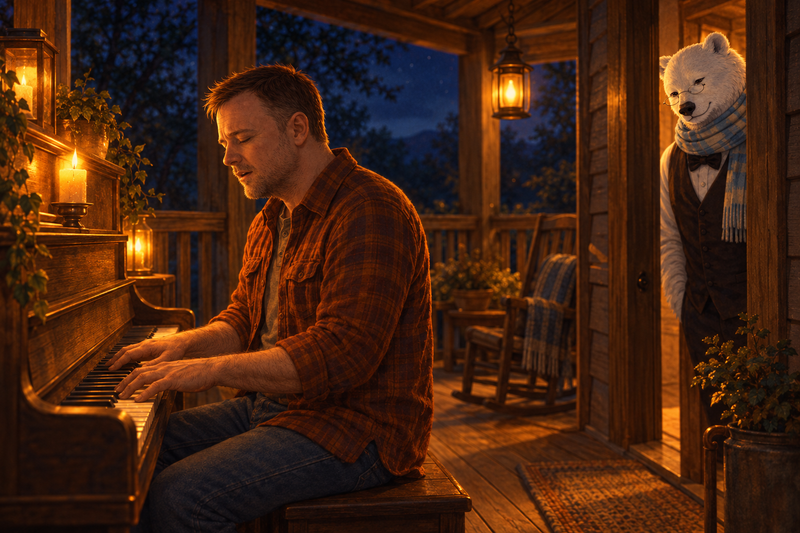
On the porch, Brent lowered the needle onto the Chet Baker record from the night it rained. The first phrase entered the dining room, crossed the kitchen and returned to its beginning before reaching the second breath.
Brent lifted the needle. He examined the record, brushed it carefully and tried again.
This time the phrase continued.
“Ugh, must be dust on the vinyl.”
Senty looked toward Clement's untouched tea.
“Probably,” he said.
Brent left the record playing. A moment later, the pass bell rang, and Senty went to finish the trout waiting beneath it. Clement carried another pot to the dining room. Brad cleared the plates while Glorp folded the foxes' bedding away from the aisle.
They had ordinary work to do, and for the rest of that afternoon it helped.
By the second morning, loose feathers covered the bottom of the basket. The Featherfoxes’ bodies showed more clearly beneath what remained. Senty changed their towels before carrying them downstairs.
At the Nook, Marty had wiped yesterday’s rain, which had not come, crossed Glorp’s seventy-one, which had, and written one new line.
Brad to lose a complaint mid-sentence: zero percent.
Brad read it over the ferret’s shoulder.
“That’s not odds. That’s just true.”
Marty capped the chalk.
“He’s never written a zero before,” Glorp said from the doorway. “I looked.”
The line remained through lunch, when Brad found Glorp stacking clean sheet pans beneath the pass in an order that made perfect sense to Glorp.
“Nine times. I have told you nine times. I have told you at the rack and at the sink and once, memorably, inside the walk-in with the door shut, that the pans go small to large so when I reach for the half-sheet I don’t have to lift the full-sheet with wet paws, and every single time you have said understood and every single time you have gone and—”
Brad stopped.
His mouth remained open for the rest of the complaint. One paw hung in the air where the gesture had been going. Glorp put down the pan in his hands.
“Brad?”
“I know what I was saying.”
“You were saying I went and.”
“I know what I was saying.”
Brad looked at the rack, then at Glorp. He did not know. He had been saying it for months. It was like reaching for the half-sheet and finding the shelf empty and knowing, with his paw, that it had been there.
Neither of them laughed.
Glorp restacked the pans from small to large. Brad turned toward the sink and let water run over his empty paws.
The Featherfoxes began whispering that afternoon while Senty was still at the pass. He felt their fear before he could make out a word.
He left the plate he was finishing and went to them.
“You're frightened,” he said, crouching.
Glorp came to the storage door.
“What are they saying?”
“I don't know. I can feel it.”
The first whispered hearth. The second gave him the one sent. The third carried something resembling a question, its ending torn away. Senty heard more than he had yesterday, but when he tried to follow the words farther, there was only the small pressure beneath his ribs.
He stayed until their whispers subsided.
Clement was waiting at the pass. The plate Senty had left stood between them, its carrots arranged more carefully than any supper required. Glorp came for a pan and stopped when Senty looked at him.
“You cleared the aisle before they came,” Senty said to Clement. “And Glorp knew what the opening was called. Both of you remembered something.”
Clement put down his towel.
“Yes. I remember the leaving better than what came before it.”
“Were we all sent through a Door like that? You and Glorp too?”
“All three of us,” Clement said.
Senty looked at Glorp.
“I remember looking for you,” Glorp said. “Then I remember a great many roads that did not have you at the end.”
The usual embroidery did not arrive. Senty wished it had.
“Why didn't either of you tell me?”
Clement rested one paw beside the plate.
“We had words. You didn't have anywhere to put them.”
Senty looked down at that paw, then back at his cousin.
“How could you know that if you never gave them to me?”
Clement did not answer immediately. Glorp lowered the pan to the rack.
“I thought saying the words would make you ask questions I couldn't answer,” Clement said. “Who sent us. Why we were separated. I still can't tell you.”
“I couldn't answer them either. I was already asking.”
“I know that now.”
“You were here,” Senty said. “Both of you. I kept trying to remember, and you were right here.”
Glorp gripped the edge of the rack.
“I wanted to tell it properly. I thought if I waited, more would come back. Enough that you wouldn't have to wonder which parts I had made up.”
Senty looked at him for a long moment.
“You could have told me you weren't sure. I wasn't sure either.”
Glorp looked at him, then down at the pan. “I could have.”
Clement drew his paw away from the plate.
“You looked happy here. I wanted to leave you that.”
“I am happy here, Clement. I wasn't asking to put this down. I was trying to understand why I remember somewhere else.”
Clement looked toward the smoke bay, where three small bodies had settled on the towels he had folded.
“I should have let you tell me what you needed,” he said. “I'm sorry.”
A pan rattled on the rack as Glorp loosened his grip. In the pit, Brad called for the half-sheets. Glorp lifted them from the rack, but waited for Senty to finish.
“I don't need you to have all of it,” he said. “But if you remember something, please tell me. Don't wait for me to ask the right question.”
“We will,” Clement said.
Glorp nodded. “Even if it's only a little.”
Senty drew a breath and looked toward the smoke bay.
“Do you know what's happening on Zanon Prime?”
“No,” Clement said. “I don't know what's frightening them. I wish I did.”
“And the tea is still wrong?”
“I made a third pot,” Clement said. “The water was right. The leaves were right. I don't think the trouble begins in our kitchen.”
Senty picked up the plate. The carrots had gone cold while the three of them stood over it.
He set it beside the rack and brought two forks. Then he returned to the stove to warm something for himself.
Clement and Glorp stayed near him while he worked.
Byron came in for the early supper and ordered by finger, as he had since the agua fresca. Two fingers on the menu. Trout. One tap. Agua fresca.
Brad brought the glass. Byron lifted it and, for the first time in a week, spoke. Brad was pleased to hear him. He had learned to wait for the words instead of hurrying a man who took the long way to a refill.
“The citrus moon has risen to its full,
and every measure answers to the pull.”
He stopped.
Brad waited for the rest. Byron was looking at the glass.
“That scanned.”
“Sounded right to me,” Brad said.
“That's what I mean. The meter was right. Usually I have to work for it—find a word that fits without losing what I wanted to say.” Byron set the glass down very carefully. “I hadn't chosen those words. I opened my mouth, and they were there.”
“Maybe you were having a good day.”
Byron looked up. Brad had intended the sentence kindly and wished, from the change in Byron's face, that he had found a different one.
“I didn't do anything,” Byron said. “It came out finished.”
Brad remained beside the table. He remembered the night Byron had finally asked him for another drink in words. None of those words had arrived easily.
“The best line I ever wrote, I fought three days for it,” Byron said. “It is not supposed to be free.”
“Do you want me to get Senty?”
Byron looked toward the pass, then shook his head.
“Let him finish the supper.”
Brad brought the trout. Byron ate it, left exact coins and went up the stairs slower than he had come down. He did not speak in meter again that night.
When Brad cleared the table, he picked up the glass first and held it a moment before carrying it to the pit.
After closing, Brad stood before Marty’s board. The zero remained uncrossed.
“You can take that down now.”
Marty looked at the line.
“Yes. I saw.”
“Then why is it still there? The rain didn't come. You wiped the rain.”
“That was thirty percent. There was room for no rain.”
“There wasn't room for me forgetting the thing I've been yelling at Glorp for months?”
“No.”
Brad looked at him.
Marty's paws were very still beneath the scarf.
“If I say eighty-eight and the other twelve happens, I haven't been wrong,” he said. “The twelve was there. I can cross the line and put up tomorrow's. But I wrote zero beside what you did. It shouldn't have been possible.”
Brad remembered the contest board. He had wanted eighty-eight to mean there was no other answer. Now he looked at the zero and wished twelve were still available.
“Well, I did it.”
“I know, Brad. I was in the room.”
There was no correction in the ferret's voice this time.
Brad lowered the rag he had brought to wipe the board.
“Could you have written it wrong?”
“I've never been wrong like this.”
“There's a first time.”
Marty looked up at him. Brad knew that look from the smoke bay, when the ferret had spent a whole service facing the wall.
“I would like that to be the answer,” Marty said.
Brad turned the rag over in his paws.
“So what do we do with it?”
“I don't know yet.”
“Leave it there?”
“It happened. I don't wipe things that happened.”
Marty pulled the scarf beneath his chin. Brad left the rag on the table beside the popcorn dish.
On his way back to the pit, he stopped at the edge of the Nook.
“Tomorrow, if you don't have a number, you don't have to put one up.”
The ferret watched him go.
That night, the Featherfoxes climbed into Senty's bed. The first came up the hanging blanket, and the other two found easier routes after it had done the work. Senty moved his feet to make room.
Much later, the window held two moons.
One belonged to Earth, pale above the trees. The other hung lower and farther away, blue-white over a black hill Senty knew he had climbed. Lights followed the ridge toward a kitchen window where someone moved in time with a low hum.
Senty sat up.
There was one moon.
He missed the other before he could remember who had been waiting beneath it.
The fountain was not running.
Senty stood at the pond at four with his mug and did not sit down. He checked the turtle's rusted mouth. It was not blocked. He put his paw to it and felt nothing behind it, no pressure, no water waiting.
The fountain had stopped as it had been stopped for years before he came. The pond beneath it was still, and the koi hung in the water like things painted there.
Milton was on his stone.
Senty sat. He did not drink. He told the frog about the moon he missed, and the hill, and the hum behind the kitchen window. When he finished, Milton did not answer.
“That wasn't judgmental,” Senty said.
He waited.
The frog sat on the stone and made no sound. After a while, Senty understood that he was not going to, and that this was not restraint.
He stayed with Milton and the stopped fountain until the stars went out.
Feathers covered the bed. They lay across the blanket, clung to Senty's fur and gathered in three small hollows where the foxes had slept. When he reached for the basket, the cobalt wristlet showed beneath his sleeve.
The outer edge had gone gray.
Senty rubbed it once with his thumb. The gray remained.
The brisket came off at two. It had come off at two every service since Smoke & Soul opened. Its temperature had held, the coals had held and the clean line of smoke had traveled through the hood for nine hours.
Senty lifted the meat to the board and cut. The bark was black. The fat had rendered. The meat was tender and cooked through.
It tasted like roasted meat.
Good roasted meat that had spent nine hours beside peach wood and had not taken one breath of it.
Senty cut a second slice, then a third. Brad stood beside him with the fire log in one paw.
“I've checked it,” Brad said. “The temperature held the whole time. Nothing went out.”
“I know. I watched the smoke.”
“I'm saying it so you don't decide this was your hands.”
Senty offered him a slice. Brad tasted it and looked toward the smoker.
“It’s cooked,” he said.
“It is.”
“We can feed people with it.”
Senty laid the knife flat on the board.
“Yes. We can.”
For an instant, rosemary filled the kitchen. A paw gripped his shoulder with more force than comfort required. Beyond it, faces turned toward a sound outside the room. Senty could not see what they saw, but he recognized what had gathered in them.
“They were afraid,” he said.
Brad turned back.
“Who was?”
The rosemary disappeared. The prep counter returned beneath Senty's paws.
“Everyone.”
“And they are waiting for you on the other side of the… Chrono Door?”
Senty nodded. He could not yet have named a face.
Brad put the fire log beside the knife and stayed until Senty picked up the knife again.
They served the brisket. Nobody sent it back, which made the absence harder to bear.
Percival did not come that afternoon.
The Featherfoxes gathered at the yellow line and watched the empty stairs. Senty sat on the floor with them. When the second one whispered, the word reached him without assistance.
“One.”
“Say it again, please.”
The fox lowered its head. A feather released from its shoulder and traveled to the floor.
Senty waited, but no second word came.
He looked toward the dark rim, then at Clement standing in the mouth of the aisle.
“Did my answer do this? I said no, and now look at them.”
“The cup was cold before you answered.”
Senty remembered Clement touching the two cups the night the foxes arrived. One still steaming. One already cold.
“Then something was wrong before they came.”
“Something was already failing,” Clement said. “The Door let both sides feel it.”
Glorp sat against the storage door, close enough to protect the aisle and far enough to give Senty room.
Senty pushed back his sleeve. The gray edge of the wristlet met his thumb. He thought of the window in his bedroom, and how quickly the other moon had disappeared.
“One,” he repeated.
The second Featherfox came to him. Its coat had thinned along the shoulders, though cobalt and copper remained along its tail.
Senty put one paw on the concrete between them.
“What happens if I stay?”
The fox placed its paw on his.
“Then there is one.”
Its voice came from its own mouth. The words were whole.
For one breath, a blue-white moon appeared above the black hill beyond the circle. Its light caught the road and showed Senty how far it went.
Then the moon faded. The road remained open, dark beyond the first few feet.
“One what?”
The fox had nothing more to give him.
Senty looked from the thinning fox to the road. He had been afraid that going back would cost him the home he had found here. Now he was afraid that staying would cost him the home he was only beginning to remember.
Senty lifted it into his lap. Its paw remained against his while the kitchen worked around them.
Brent found Senty on the porch after midnight.
The Chet Baker record was turning on the table, repeating three seconds of trumpet: a breath, the beginning of a phrase and one low note before returning to the breath. Brent sat beside him. For a while they listened to the same beginning.
From the fountain beneath the pecans, nothing.
“Did it stop today?” Brent asked.
“This morning. Milton isn't making any sound either.”
Brent looked toward the dark pond.
“That fountain started when you came.”
“I know. I tried to find something blocked. There wasn't anything.”
The trumpet returned to its first low note.
“Do you want me to take that off?” Brent asked.
“Not yet. I keep thinking it'll get to the next part.”
Brent left the record alone.
“I remembered more of home,” Senty said. “There are good things. Two moons. A kitchen light. Somebody humming beyond a doorway. I can feel how much I wanted to get back to that kitchen.”
He turned the wristlet beneath his paw.
“Today I remembered people being afraid. I couldn't see what they were looking at. I only know they were.”
Brent rested his hands between his knees.
“You said you were glad I said no,” Senty said.
“I was.”
“Are you still?”
Brent looked at him, then toward the yard. The trumpet began again before he answered.
“I'm glad you chose us. I don't know if that's the same thing anymore.”
Senty lowered his eyes.
“Last night I thought going back meant giving this up,” he said. “Our kitchen. My work. You.”
“I wouldn't want you to give any of that up.”
“I don't think that's what they're asking. I said no because I thought staying was how I kept this place. Now I think staying may only be how I avoid finding out what happened to the other one.”
The two of them sat with that while the same breath returned from the record.
“I don't want to go,” Senty said. “I want it to be all right without me.”
Brent's hand moved along the edge of the bench until it rested beside Senty's paw.
“I think I have to go through that Door.”
“Okay,” Brent said.
Senty heard acceptance in the word. He did not yet know how much else Brent had put there.
“I'm not ready to say the rest.”
“Then don't say it tonight,” Brent said.
He looked at the hand beside his.
“Brentusha.”
Brent stayed beside him, their shoulders touching whenever either drew a deep breath. The needle continued traveling toward the center of the record.
The music stayed where it was.