More Like the Porch
Settle in. Press play when you're ready.
▶ Listen on the porchBrent noticed the missing hum before he noticed Teddy.
That was what more than forty years at a piano did to a man. It taught him that absence could keep time.
Every service since Smoke & Soul opened, the old otter had settled into the same chair with his cane against one knee and some low piece of Otis moving behind his closed mouth. He never performed it. He gave it to the room in portions too small to embarrass either of them.
Tonight, the chair was occupied and the music was not.
Brent let his left hand carry the supper hour while his right found a quieter path through it. Across the room, Teddy sat with both paws around an untouched glass. A few folded pages showed above the edge of his waistcoat pocket. He reached toward them once, stopped, and returned his paw to the glass.
At the Nook of Implied Probability, Marty took up his chalk.
“Glorp to mistake the salt for the sugar tonight: sixty-two percent.”
Glorp looked up from the sideboard. “I reject the premise that the jars have fixed identities.”
“Brad to break a dish: four percent.”
From the dish pit, Brad scoffed.
“Haven’t broken one yet.”
Marty wrote the number and said nothing more. Four percent did not require defending.
Senty was at the pass with a towel over one shoulder, finishing a plate that had already been finished once. His eyes moved to Teddy, then away. He had noticed the silence too.
Brent changed keys.
He did not look at Teddy while he did it. He simply opened a little more space in the song and left it there.
Teddy heard the invitation.
His paw entered the breast pocket. This time it came back with the pages.
“Excuse me, Brent.”
The piano softened beneath his name.
Teddy stood. His legs took a moment to accept the arrangement, but they accepted it. He crossed to the piano with the pages held in both paws.
“I wrote something,” he said. “Some time ago.”
Brent waited.
Teddy glanced toward his chair, as though it might still permit him to return unchanged.
“I have never had a room I trusted enough to sing it in.”
“Well, Teddy, sing it here.”
The answer came so easily that Teddy seemed to trust it less than persuasion.
He looked down at the pages.
“There is a horn in it.”
At the pass, Senty’s paw stopped against the plate.
“There has been a horn in this song for a year,” Teddy said. “Three weeks ago, I heard that same horn above this house.”
Senty looked at him.
“Last night, after supper, I asked Marty whether I would hear it again.”
From the Nook, Marty said, “You asked whether the odds favored a recurrence.”
“And you told me to ask Senty.”
Marty returned his attention to the board. “Yes, I did.”
Teddy held Senty’s gaze.
“I never had anyone to play it.”
The towel slipped from Senty’s shoulder. He caught it before it reached the floor.
“Teddy—”
“I am scared to sing mine,” Teddy said. “You look scared to play yours.”
Senty folded the towel once. The first fold went wrong. He opened it and tried again.
“I haven’t played it in front of the room.”
“That’s okay, my beautiful bear. I haven’t sung in front of it.”
The old otter adjusted his waistcoat by a fraction.
“Might be a good night for both of us to be scared.”
Senty looked toward Brent.
Brent kept his hands resting on the keys and left the decision where it belonged.
Teddy consulted his cane.
“Also,” he said, “I am an old otter, and I would like to hear the damn horn.”
Senty’s mouth moved at one corner.
“Give me a minute.”
Three weeks earlier, the blue had come down from the roof with Senty.
By morning, he had placed it in the top drawer beside his bed, plainly enough to find again and far enough from daylight that it could not ask what he intended to do with it.
Tonight, the drawer opened on the first pull.
The wristlet rested against the dark wood, cobalt and quiet.
Senty put one paw around it.
He could still go downstairs without it. Teddy could sing the song as he had written it. Brent could carry the room. Nobody would accuse Senty of failing a thing he had never promised to do.
His thumb moved across the smooth blue band.
There was a road behind the fog. Each time he tried to face it, it changed direction. But the wristlet did not move.
He lifted it from the drawer.
“Play.”
The night made room for it.
A cobalt-blue alto saxophone settled into his paws, cool and solid. His fingers knew the keys. That part had never been the reason for the drawer.
At the bottom of the stairs, Clement stood beside the kitchen door.
Senty stopped one step above him.
“I don’t know if I can carry it into the room.”
Clement looked at the horn, then at Senty.
“It was a gift from home,” he said. “Play it like one.”
He opened the door.
Senty went through.
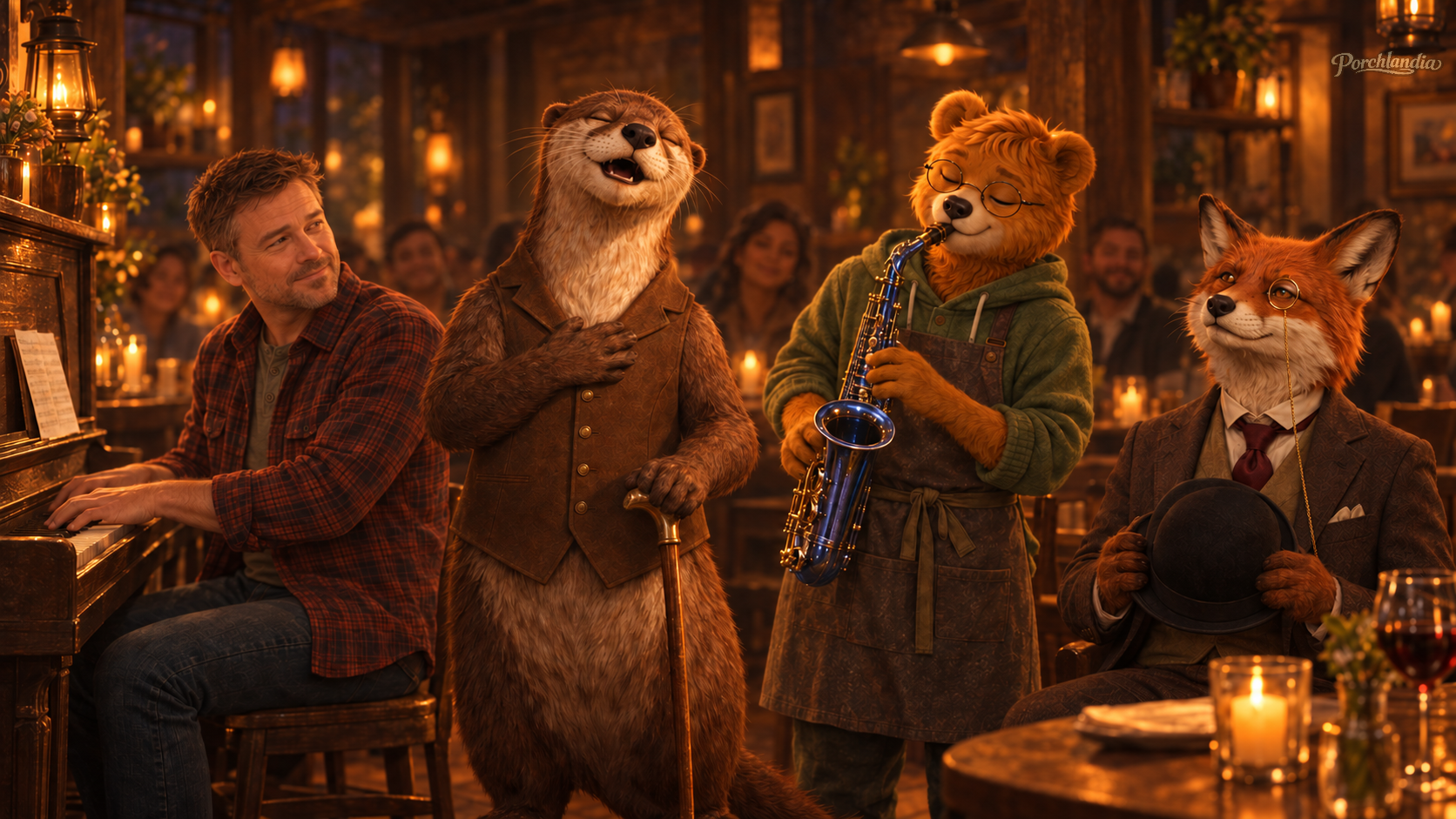
Teddy stood beside the piano with one paw resting on his cane and the other holding the pages. Brent gave him the first chord.
The opening note came from low in the otter’s chest and crossed the room without strain.
I was raised where the river ran clear, he sang, where the stones wore a silver shine.
The song carried dragonflies, reeds, roots and water cold enough to wake a child completely. Then the river changed. Bottles caught the sun. A rainbow lay across the surface that no heaven had made.
At the sideboard, Glorp reached for a white crock.
“Other one,” Brad said from the dish pit.
Glorp checked the crock in his paws, checked the peach cobbler, and replaced the salt with the sugar.
“I was testing you.”
“No, you weren’t.”
Neither of them missed the song.
Teddy reached the line he had been afraid to give a room.
We were meant to be keepers, he sang, not kings with hungry hands.
Senty stood just beyond the piano’s curve with the saxophone against his body. The opening Teddy had written for it approached.
He nearly let it pass.
Brent did not turn his head. His left hand stayed beneath Teddy’s melody. His right gave Senty one clear place to enter and left the choice untouched.
Senty drew breath.
The first note arrived low and blue beneath Teddy’s voice.
Brent heard years in it—the kind that settle into breath and bone. His hands continued, but the question inside him lifted its head.
Senty kept to Teddy’s melody and stayed beside it.
When Teddy sang of the heron standing in ruined water, the horn held the river as it had been. When he sang of the porchlight, the supper smoke and the kindness set down without announcement, Senty answered with three quiet notes that asked for nothing.
Teddy’s voice strengthened.
Maybe mercy does not have to shout, he sang. Maybe hope is just a doorway someone keeps from closing out.
The room listened. The possums forgot the rolls between them. Percival Finch removed his bowler. Constance took it and held it in her lap. At the dish pit, Brad set one clean plate securely into the rack before reaching for another.
Teddy carried his own song to its final chorus.
Let the hungry be answered. Let the lonely be seen. Let the broken water carry one more ribbon of green.
Senty played under him, never ahead. Brent kept the floor beneath them both.
Then maybe someday, if we tend it right, the world can be more like the Porch tonight.
Teddy sang the last word himself.
The horn remained with him until it was safely gone.
Then Senty lowered it.
For a moment, the room was simply quiet.
Teddy opened his eyes.
“Thank you for the accompaniment,” he said.
His composure had returned, but it no longer fit him in quite the same places.
“Thank you for asking,” Senty said.
Teddy folded the pages. The crease missed its old line. He left it that way.
Closing began around them.
Glorp approached Senty with three questions already gathering behind his teeth. Brad placed a towel and a rack of glasses into his paws.
“Dry.”
Glorp looked at the glasses. Then at Senty and the cobalt horn.
“All of them?”
“Every glass in the known world.”
Glorp accepted the assignment at its stated scale.
Clement took Senty’s place at the pass. Brad began washing. Glorp dried. The two of them found a workable rhythm and stayed inside it.
Teddy stopped beside Senty on his way out.
“I believe you improved the evening.”
“You did the difficult part.”
Teddy considered that.
“We both arrived,” he said.
He consulted his cane and went out along the dark road humming a little Otis to himself.
Senty looked down at the saxophone.
“Hold.”
Blue metal folded inward until the wristlet rested in his paw. He fastened it around his wrist, but pulled his sleeve over it before turning back toward the kitchen.
Brent had seen.
He closed the piano and followed.
At the dish pit, Brad set the final plate into the rack and looked across the room at Marty.
“Didn’t happen.”
Marty looked up.
“What didn’t?”
“The dish. I didn’t break one.”
“Well,” Marty said, “it was four percent.”
Brad stared at him.
Glorp held up a dry glass.
“Four is extremely small.”
“You are not helping.”
“I am helping with every glass in the known world.”
Brad took the glass and racked it.
“That one’s dry.”
It was as close to praise as closing required.
In the kitchen, Senty made hot chocolate.
Cherries first. Dark chocolate beneath them. A little heat at the end, arriving only after the sweetness had finished speaking.
He carried two cups to the long table and sat across from Brent.
The wristlet remained beneath his sleeve.
Brent wrapped both hands around his cup.
“That was beautiful.”
“Thank you.”
“I want to say that before I make a mess of the rest.”
Senty waited.
“More than forty years of playing buys you a few things,” Brent said. “Mostly sore hands and the right to complain about tempos. But it also lets you know what you’re hearing.”
His thumb moved once along the handle.
“I heard a lifetime in that horn.”
Senty looked at the dark surface of his cup.
“It’s okay, Brentusha. Ask me.”
“I don’t know how to ask without making you sound like a question.” Brent raised his eyes. “And I love you too much to ask it wrong.”
“Then let me answer first.”
Senty pushed his sleeve back. Cobalt rested against his wrist.
“I’m not from here.”
Brent’s mouth found half a smile.
“You’re not from Texas?”
“I’m not…from Earth.”
The smile left, but Brent did not.
His eyes stayed on Senty. The door, the ceiling and every possible hiding place for proof went unsearched.
“The horn?”
“Someone from home brought it to me. Someone who knew what I was before I did.”
Brent glanced at the wristlet.
“Is that why you kept it upstairs?”
Senty turned his wrist once.
“I could wear it at night. I could not carry it into day.”
“Until Teddy.”
“Until I saw him do the thing I was avoiding.”
The cups stood between them. Steam rose and disappeared.
“The fog is still there,” Senty said. “But it has moved enough for me to know my name.”
“Of course you know your name. You’re Senty. S-E-N-T-Y.”
“I’m Senty Sterling Martindale.”
Brent went still.
“Senty was selected for me,” the bear said. “It wasn’t a name my family gave me.”
His paw closed lightly around the cup.
“It’s mine now.”
Brent received that without trying to improve it.
“Sterling was given to me by a friend. I cannot see the friend clearly yet, but I know the name was given in love.”
Senty took a breath.
“Martindale was given to me by a family. There was a kitchen. There were people who fed me, and taught me how to feed others.”
He looked across the table.
“That is as far as I can reach tonight. I wanted you to have what is true.”
Brent sat with it. The kitchen made its ordinary sounds around them: the cooling tick of the stove, water moving through a pipe, Glorp dropping something harmless in the next room and Brad telling him exactly where it belonged.
“I don’t have kids,” Brent said.
The words came plainly.
“Came close. Couple of times. You can love somebody and lose them. And the window can close so quietly you don’t hear it go.”
Senty gave him the silence he needed to continue.
“I’ve been trying to figure out what you are to me since the night you asked if I minded that you sit.” Brent looked down at his hands. “I’m not sure whether you’re my brother, my son, or the best friend I’ll ever have. Maybe a bit of all three.”
He looked at Senty.
“Every word is too small. But I know you’re my family. That part’s done.”
Senty’s eyes lowered to the space between the cups.
Brent breathed once.
“So, if you’re open to it—”
He stopped, found the simplest version, and trusted it.
“Maybe you could add Brooks to the end of that name.”
Senty looked up.
“There’s room enough for four,” Brent said.
The bear touched two fingers to the wristlet at his wrist.
“Sterling was given to me by a friend. Martindale was given to me by a family.”
Brent waited.
“Senty was once chosen for me. Then I chose it for myself.”
He let the last name find its place among the others.
“I have learned not to put down a name given in love.”
Then Senty said it slowly, each word carried all the way into the room.
“Senty Sterling Martindale Brooks.”
Brent’s eyes shone. He smiled through what it took.
“May I?”
Senty nodded.
Brent said the whole name back to him.
“Senty Sterling Martindale Brooks.”
The final word arrived differently in Brent’s voice. It had been offered; now it was received.
“Yeah,” Brent said. “That’s the one.”
They sat until the hot chocolate went cool.
First light reached the kitchen in a thin gold line.
Senty stood at the stove with his sleeves pushed above his wrists. Cobalt showed against his fur in the first light.
Brent stopped in the doorway.
“Morning, Senty Sterling Martindale Brooks.”
The bear looked at him, then at the blue he had carried all the way into day.
“Morning, Brentusha.”
He turned back to breakfast smiling.