A Lot Less Stupid
Settle in. Press play when you're ready.
▶ Listen on the porchThe coffee machine had a full carafe of yesterday still in it.
Gary Beacher looked at the dark glass, looked at the clock, and decided there was no time to hold an argument both sides had already lost. He left without coffee. Without toast either. He was late before he started, which was a sentence he could have carved over the door of the whole year.
At the door he ran the inventory of a body that had done the same job for thirty years: keys, bag, knee. The knee checked in as it had since 1991—early, specific, and unwelcome. The cap stayed on its hook. Same as every morning.
The house behind him held one mug in the rack, one chair pulled out from the table, and a counter of mail that was all envelopes with windows in them. Gary locked the door without looking back through the glass.
The morning had routes to keep.
The package was in his tray and it should not have been.
Somebody upstream had mis-sorted it: wrong case, wrong route, one small mistake traveling toward him through a system built to keep small mistakes moving. Gary stood beneath the station lights with a medium parcel addressed to B. BROOKS and did a late man's math.
He knew the name. Everybody who worked the cases knew the neighboring routes as surely as towns they passed on the highway but never entered. B. Brooks had occupied the next case over for years, a life arriving in envelope-widths: statements, catalogs, cards in December, square packages with patient handwriting. Gary had never carried any of it. He had never met the man.
The address meant a detour. The correct move was to send the parcel back through and let it arrive tomorrow on somebody else's feet.
He set it beside the tray.
He picked it up again.
It was mail. It was here. Gary delivered the thing even when it cost him. That was either the best of him or the whole problem, depending on the hour.
He put it in the bag.
The address took him beyond the last sensible turn on his route, down a road with no interest in helping him recover the time. The houses loosened. The trees moved closer. At the end of a long drive stood a porch that looked less built onto the house than listened out of it.
The smell reached him at the gate.
Butter first. Then heat. Something sweet beneath both, browned at the edges. It moved through the morning with purpose, not wandering but aimed. Gary stopped with one hand on the latch while his empty stomach forgot its complaint and paid attention.
He climbed the porch steps with the package held where anyone could see it. A legitimate errand. Nothing else to account for.
The door opened before he knocked.
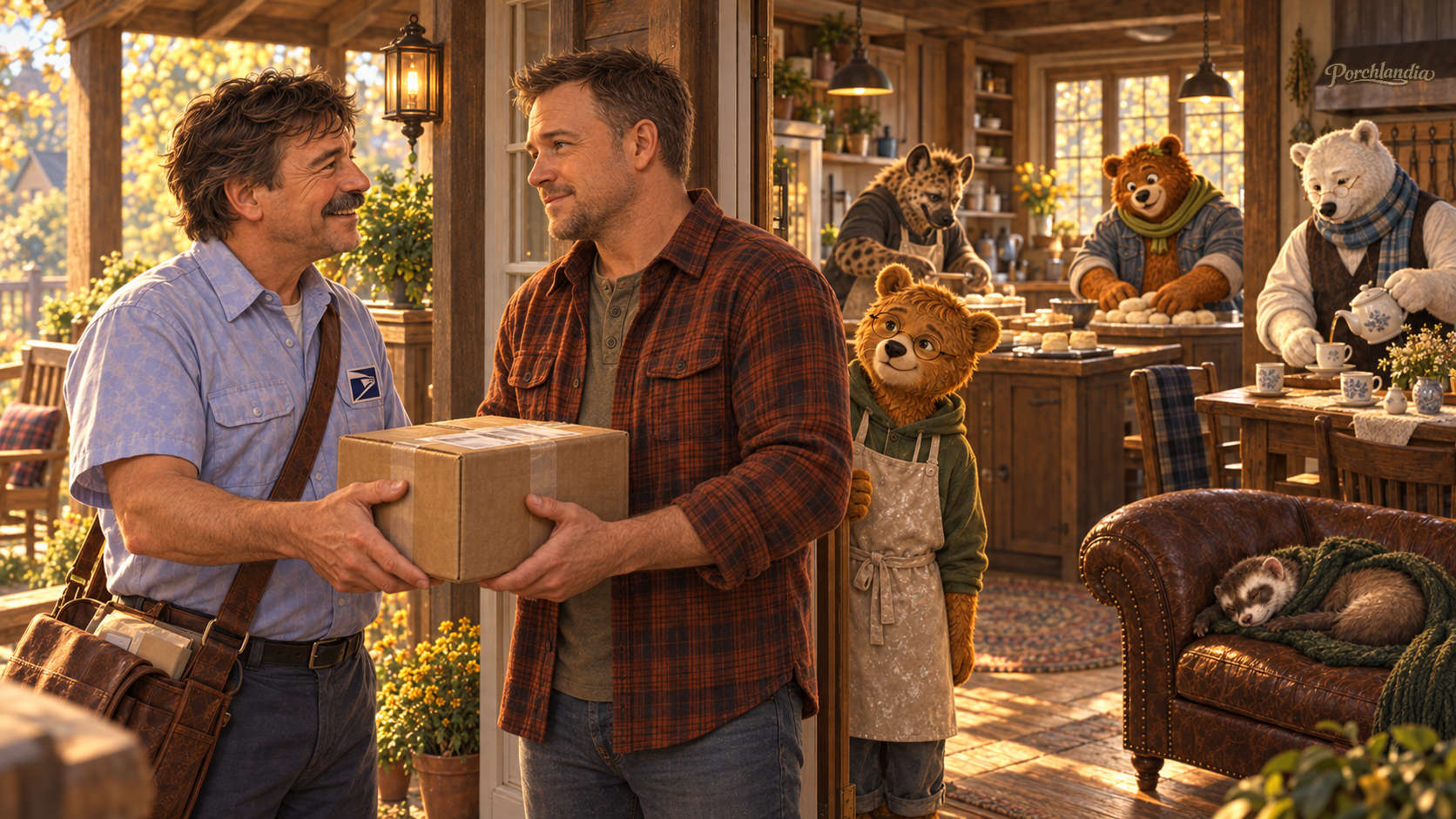
A young bear opened it.
He stood barely five feet tall, small for a bear, golden-brown, with a teenager's open face and paws that seemed a year or two ahead of the rest of him. His apron was flour-dusted. His attention was not. He gave Gary the sort of attention people almost never did: all of it, first.
"You're not interrupting," the bear said.
Gary had not said anything about interrupting. He had not said anything at all. He was a fifty-six-year-old man on a stranger's porch being read his own worry by a bear, and the strange part—the part he would turn over later—was that it did not feel strange. It felt like someone taking the heavier end without asking what was in the box.
"Package," Gary said. "For Brooks."
"That's Brent." The bear glanced toward an upright piano near the far end of the porch. "He's right over there."
The man at the piano rose and crossed the boards. He stood about six feet, with the unhurried posture of somebody who let a chord finish before asking a sentence to begin. He had been testing the same one from several angles, never quite deciding against it. Now he took the parcel with both hands and read the label.
"Brent Brooks," he said. "Thank you for bringing it yourself."
"Gary Beacher."
The name came out before Gary had decided whether the delivery required one.
Brent turned the parcel over once and looked up.
"You came out of your way."
"It was mail."
Brent nodded, and that appeared to settle the entire matter for him.
He looked toward the open kitchen door. "Senty, would you mind making room at the table?"
The young bear smiled.
"Clement heard the gate. The room is already there."
Gary should have handed over the package and left. Instead he followed the smell through the open door.
The morning went inside with him.
Brent's kitchen was a kitchen the way a church is a building. The description was accurate and missed nearly everything.
It opened directly off the porch, close enough that the piano remained in view through the broad doorway. Morning light lay across the counters. A ceiling fan moved flour through its slow rotations. The room was ordinary in all the measurable ways: sink, stove, scarred table, cupboards whose hinges had learned everyone's reach. What made it strange was how little the strangeness needed to announce itself.
Clement stood beside the table with a teapot lifted over one cup. He was a young polar bear, perhaps six-foot-five, wearing glasses that should have made him look scholarly and instead made him look as though he had already understood the morning and saw no need to hurry it. His height should have crowded the kitchen. His stillness made room.
He had already turned one chair slightly toward Gary—not enough to make an occasion of it, only enough to remove the work of choosing.
"Good morning," Clement said.
It was not a question. Gary appreciated that.
"Morning." Gary looked at the chair, then at the clock over the stove. "I got thirty seconds."
"That is enough for tea."
Clement poured it and left the cup beside the open place, as though thirty seconds were a unit of hospitality he worked in all the time.
Gary blamed the smell. Then the chair. The day was already late.
He sat on the forward edge like a man prepared to deny he was sitting.
The kitchen had divided itself around two counters.
At one, a hyena stood around five-eight, compact and quick-handed, working a pale square of dough with his sleeves pushed up. Every motion was measured and close to the body.
At the other stood another young bear, perhaps six-three, wide through the chest and stout through the middle, with the easy strength of something built to move a refrigerator and then forget anyone had been worried. He was the loud one in every visual sense. His hat entered arguments before he did. When he spoke, though, he kept his voice low, as if the words themselves deserved privacy.
They did not speak at first. They did not look at one another.
Yet the hyena shifted half a step before the broad bear opened the flour bin behind him. The bear moved a hot pan off the stove just before the hyena reached for the burner. A crock of salt traveled from one station to the other without either creature seeming willing to admit who had moved it.
They knew each other's weather. That much Gary could tell. Whatever had happened between them had not made them strangers. It had made them careful.
There was an empty stretch of counter in the middle, about the width of a bowl.
By every sensible accounting, Gary should have been afraid. Three bears in a kitchen. A hyena holding a bench scraper. One human, one open door. His mind arranged the facts and waited for his body to understand them.
The fear did not come.
The porch remained open behind him. Brent's piano worried the same patient chord. Clement poured tea as though nothing in the world needed proving before breakfast. The place felt peaceful. Welcoming. Almost healing, if Gary had known better than to believe a house could do that.
He did not fully understand why. He only knew his shoulders had lowered since the gate.
Gary knew the silence from depot break rooms and other people's kitchens: two people working close enough to share heat while every utensil stood in for a sentence. It was none of his business. His bag rested against his shin. The porch door stood open behind him.
The hyena pressed the dough flat with the heel of one hand. The bear glanced over, then away too late.
"Glorp, if you have something to say about my dough, say it before it goes in the oven." The hyena kept his eyes on his hands. "I have had enough of verdicts arriving after the fact."
Glorp's paws stopped in the bowl.
"I wasn't looking at the dough, Brad. I was making sure you were still here."
Brad held the fold between both hands. The kitchen waited with him.
He did not answer. Not directly.
He folded the dough over itself—one final fold, gentler than the others—and said, low, to the dough or to somebody who was not in the room:
"Fold the dough like a memory."
Gary looked down at his tea.
The chair had all four legs beneath him now.
He stayed.
The biscuits came out of both ovens within five minutes of each other, close enough to suggest coordination and far enough to preserve the argument.
Brad's rose in clean, soft layers, each one holding the next without being pressed out of shape. He lifted them from the pan with a folded cloth and arranged them on a plate by touch, turning the browned sides outward.
Glorp's came out irregular and golden, leaning into one another as though something interesting had happened in the oven and none regretted attending. Their smell carried butter and pepper and one bright note that had no business in a biscuit. Gary could not have named it under oath.
The two plates reached the kitchen table from opposite directions and came to rest side by side.
Nobody announced a contest. The serious ones rarely needed announcing.
Brad wiped a spotless place on his counter and studied the plates from a judicial distance.
"Yours leaned."
"They lean on each other," Glorp said, low. "It is a load-bearing design."
"Biscuits don't have architecture."
"Yours do. I counted the floors."
Brad opened his mouth, decided the reply was beneath both of them, and wiped the counter again.
Gary saw the trap before anyone offered it to him: two cooks, two breakfasts, and a choice that would travel farther than anything in his mailbag.
Brent had returned to the piano, but now he turned on the bench and rested one arm across its back.
Gary watched the request form in his face and wished him better judgment.
"Would you settle something for us?" Brent asked. "You're a judge now."
"Fellas." Gary lifted his tea an inch, evidence of prior commitments. "I just work for the post office."
"Then you're impartial."
"I deliver verdicts. I don't write 'em."
"Well," Brent said, glancing at the parcel on the piano bench, "today one got mis-sorted to you."
Clement placed an empty plate before him. Senty brought both biscuits over and set them down without ceremony.
"Nobody is grading you, Gary," Senty said. "They are grading each other."
No one budged.
Gary ate Brad's biscuit slowly because it asked him to.
That was the honest description, and he never improved on it. The biscuit had been made by hands taught by hands. It opened in warm layers and left butter on his thumb. Gary, who had eaten standing at a counter for more years than he could defend, sat there and gave it the time it wanted.
For a moment he remembered a kitchen without recovering whose kitchen it was. A flour sack folded beneath a drawer. Sunlight across a chipped yellow bowl. Someone telling him not to work the dough angry.
Then Brent's kitchen returned.
Brad was watching the plate, not Gary.
Gary ate Glorp's biscuit because he had to know.
It should not have worked. Whatever bright thing Glorp had folded into it arrived late, after the butter and salt, a joke revealing itself as true. Gary chewed once more than necessary. Across the room, the loud one tried not to look hopeful and failed with his whole face.
Brad's eyes narrowed—from Gary's face to Glorp's.
"You didn't."
"A little," Glorp said.
"It's not Tuesday."
"It travels."
None of it meant anything to Gary, and nobody offered to help it mean.
He set both halves on the plate.
Brad had stopped wiping the counter. Glorp's paws remained folded. Clement paused with the teapot lifted. Brent rested one hand on the piano. Senty stood in the open doorway between porch and kitchen, one shoulder against the frame. In the corner, something small slept beneath a long green scarf with the stillness of a creature who had already read the ending and found no reason to hurry anybody toward it.
A great deal had gathered around one tired man's breakfast.
Gary looked at the first plate. Then the second. Then at Brad and Glorp, waiting to find out which of them the room would keep.
He could not give them that answer. He did not have it.
"Fellas, I'm not gonna lie to you. I haven't eaten since around six. I'm already late." He looked down at the plate again, genuinely sorry. "And both of these are incredible, and I don't know how to pick."
The kitchen held still.
Brad looked at Glorp.
Not at Glorp's biscuits. At Glorp.
Glorp looked back.
Something passed between them that Gary could not read. It seemed older than breakfast and younger than whatever came next.
Brad made one short sound, almost a cough. His mouth tightened against another. Then the laugh got out.
It struck him sideways. One bark, startled and unwilling, followed by another that bent him over the counter. He slapped one palm against the wood as though trying to keep the room steady. Glorp stared at him for half a second, offended by nothing Gary could see.
Then Glorp caught the far end of the laugh.
His came up from lower down and arrived with no manners at all. It rolled across the empty counter between them. Brad heard it and lost whatever little control remained. Soon they were laughing at each other laughing, long and helpless, like something stored too high for too long had finally broken through its shelf and brought half the cupboard with it.
Gary sat with a biscuit in each hand.
He had told the truth by accident. He could not imagine why the truth was this funny.
Senty watched the two of them until the laughter began to spend itself.
Then he said, quietly:
"That's what the kitchen is for, boys."
No one answered.
Brad picked up a pan from Glorp's station and carried it to the sink. Glorp slid a bowl down the counter. Brad's paw was already there to receive it.
The bowl came to rest between their paws. Both stopped. Brad looked at the hand he had raised without thinking. Glorp looked at him.
A smaller laugh passed between them.
"Your layers held," Glorp said, to the bowl.
"Yeah." Brad set it in the rack. "The lean worked."
Neither of them looked at the other while the compliments changed hands. It was safer that way.
Gary had known their names for less than half an hour. He did not know enough about either creature to call it friendship. He only knew the room sounded different afterward.
After that they moved around one another with the awkward ease of people whose bodies remembered cooperation before their pride had approved it. The counters stopped being positions and went back to being counters. The empty space in the middle filled with flour, a dish towel, the crock of salt, and finally both plates.
It wasn't fixed. It was more like a road reopening one lane.
For the first time that morning, nobody appeared to be directing traffic.
They fed him.
Nobody asked him anything, that was the thing.
Not why he had left a route sitting in a truck while he ate biscuits in a stranger's kitchen. Not where he was from, how long he had carried mail, whether there was anyone waiting at the house he had left without breakfast. None of the questions that make a man assemble himself before answering.
Clement poured tea without hovering. Brent turned back to the piano and found a few quiet chords that left the room as it was. Brad and Glorp cleaned their stations badly together, discovering fresh reasons not to agree.
"You're drying that wrong," Brad said.
"I am drying it differently."
"It's still wet."
"It is resting."
Every so often they looked at one another with the dangerous beginning of another laugh.
Gary's plate refilled while he was looking elsewhere. The tea stayed hot at his elbow by some mechanism he declined to examine. The house continued its morning and somehow left him inside it.
Once—only once—Senty looked at him from the doorway a half-second longer than the morning explained.
The look landed south of the biscuits, in the part of Gary that ate standing at a counter in a house with one chair pulled out.
Senty did not go after it.
He took four biscuits from the two plates, two of each, and laid them on a clean cloth.
Senty set the bundle beside Gary's bag.
"For the route," he said. "Two of each."
"It's a long route."
"That is why there are four."
On the chaise, one small eye opened beneath the green scarf. It regarded Gary without welcome or suspicion, only accuracy.
Then it closed.
"Marty has strong opinions about visitors," Brent said from the piano.
Gary glanced toward the scarf. "He can keep 'em."
Brent smiled and played the chord he had been looking for when Gary arrived.
Gary finished his tea.
No one asked him to stay.
No one hurried him out.
There was a difference, and he felt it.
At the bottom of the porch steps, Gary stopped.
He did not usually turn back after a delivery. The next address was the next address. Whatever a door became after it closed belonged to the people behind it.
This door had remained open.
Brent stood beside the piano. Senty was in the kitchen doorway behind him. Farther in, Clement lifted the teapot while Brad and Glorp carried the same tray from opposite ends, neither apparently willing to surrender his half.
Gary raised the wrapped biscuits a little.
"My day got a lot less stupid," he said.
He meant it as a joke.
It came out as a receipt.
Brent smiled.
"You know the address now."
"I do now."
Senty put one paw against the doorframe, as though accepting delivery.
Gary returned to the truck with half a bag, half an hour gone, crumbs on his uniform, and something warm tucked beneath his arm.
The lost half hour no longer felt misplaced.
The route kept its appointments.
The mail was the mail. The dogs were the dogs. Gary's knee announced every porch stair at the Hendricks place, same as always. The bundle rode in the passenger seat with its knot turned toward him.
At the turnaround he ate one biscuit leaning against the truck. He chose the crooked one and discovered the impossible bright taste again. It remained impossible. Gary laughed once, alone beside the open door, at nothing he could have explained.
The bundle grew lighter as the route went on. He saved one without examining why.
Near the end of the afternoon he reached the house with the storm-glass door. It always showed a shape moving slowly toward him after he had placed the mail in the box. Gary had outwalked that shape politely for years. There was a schedule. There were miles left. The person always reached the door eventually.
Today Gary slid the envelopes beneath his arm and waited.
He had not decided to. By the time he noticed, the inner door was open.
An older woman stood behind the glass, one hand working the latch. She looked surprised to find him there. Then she looked at the mail in his hand and was not surprised anymore.
Gary passed it to her directly.
"Thank you," she said.
"Yes, ma'am."
The door closed. Gary walked back to the truck.
That was all.
The house that evening held what it always held.
One mug. One chair pulled out. Windowed envelopes waiting beneath the kitchen light.
Gary placed the last biscuit on a plate. He could have eaten it standing at the counter. He stood there long enough for the old choice to recognize him.
Then he pulled the chair out farther and sat down.
The biscuit was still good cold. It opened along the fold instead of breaking apart. Gary ate half, rested his hand beside the plate, and listened to the quiet.
His ears rang in it softly, same as ever.
But the quiet did not seem to be waiting for him to explain himself. It simply kept him company while he finished eating.
Gary brushed the crumbs into his palm. He thought about Brad and Glorp laughing until they could work beside each other again. He thought about Senty in the doorway and the seven words Gary had not understood but had carried all day anyway.
He left the plate on the table.
The next morning, the coffee machine was already talking to itself before he picked up the keys and the bag.