The Bear Who Testified
Settle in. Press play when you're ready.
▶ Listen on the porchTrouble came not with fire, but with font.
A letter, crisp and cruel, arrived in Brent's mailbox on a Tuesday afternoon when the sky had the look of not caring about anyone's plans. The return address read: North Porch Homeowners Association, Compliance Division.
Brent opened it standing at the curb, still holding his keys.
"You are in violation of subsection 3.4.7 of the North Porch Homeowner Aesthetic Compact."
And beneath that, in smaller font that somehow felt louder:
"Unlicensed subterranean food establishments will not be tolerated."
Brent read it three times. Laughed once. Then sighed. Then stopped laughing.
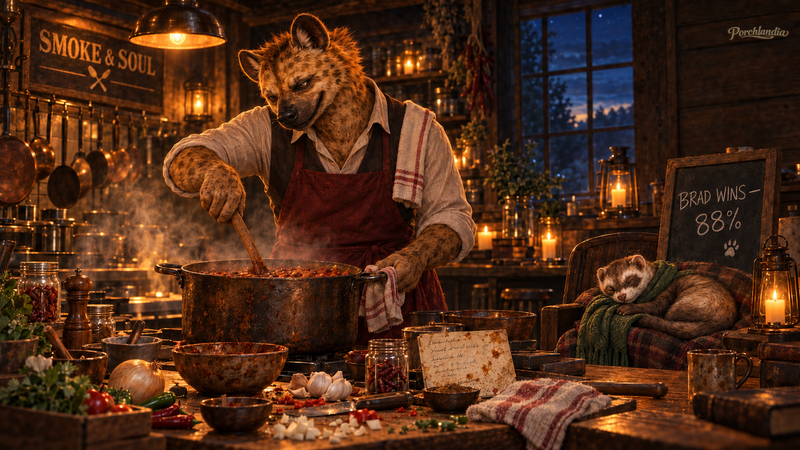
The HOA, that eternal tribunal of brittle lawn enthusiasts and emotionally constipated bureaucrats, had caught wind of Smoke and Soul. And they were not amused by the scent of brisket drifting over property lines at dusk, or the reports of jazz music past 10 p.m., or the fact that a restaurant with no posted hours and no visible signage from the road somehow had a waiting list.
A summons was issued.
Brent Brooks was to appear before the board on Thursday evening to answer for his crimes against aesthetic uniformity.
The night of the hearing, he put on his best flannel, the one with fewer coffee stains, and walked.
The community center was a mile into town. He didn't take the car. The car felt wrong for what this was. He needed the distance under his feet.
Streetlights came on one by one as he passed beneath them. A dog barked twice and quit. Somewhere a screen door slammed and a kid called for someone named Marco. The neighborhood was doing what neighborhoods do at dusk, indifferent and intact, and Brent walked through it carrying a folded summons.
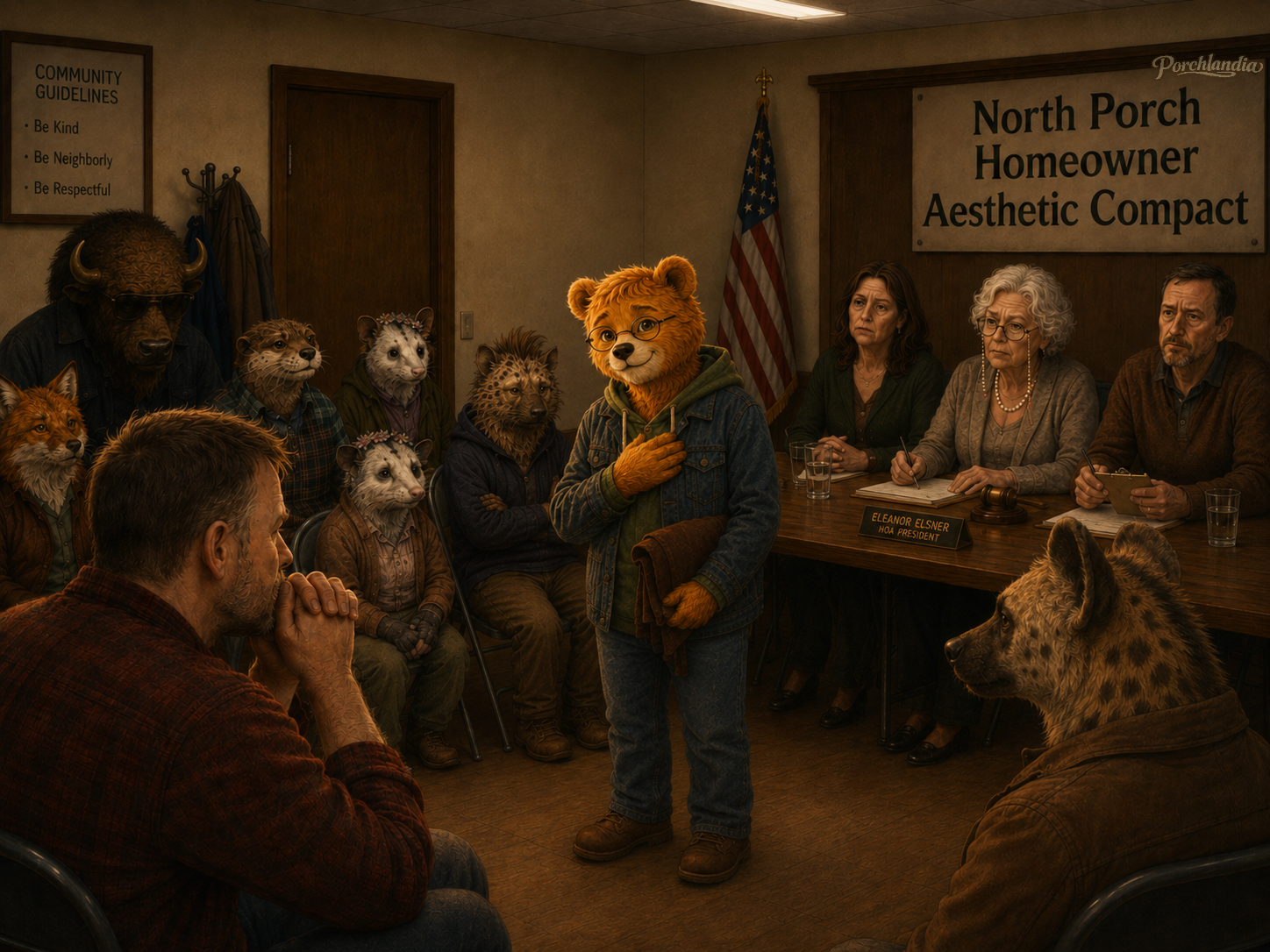
The hearing room was exactly what he expected: folding chairs, a drooping flag, and a long table where five people sat with clipboards held like shields.
At the center: Eleanor Elsner. Gray cardigan, pearls cinched tight, reading glasses on a chain. Decades of enforcing rules she didn't write but had come to believe in anyway.
Brent sat in the front row.
In the back: Theodore the otter in a waistcoat, paws folded over the head of his cane. Beside him, Percival Finch in his bowler hat, paws folded, watching with quiet attention. The possum couple whispering in their flat, considering way.
And in the far corner, partially obscured by a coat rack: a bison in sunglasses and a dark canvas jacket. Sitting very still. Writing nothing. Just watching.
Eleanor tapped her gavel.
"Mr. Brooks, are you aware that your porch has become a commercial enterprise?"
Brent's mouth opened. Closed. His hands shook hard enough that he shoved them into his pockets to hide the tremor. The words he had rehearsed on the walk over had abandoned him at the threshold.
"I wouldn't… it's not really…"
"Do you deny there is a fully operational kitchen under your foundation?"
"I wouldn't call it fully operational. The jam shelf still collapses sometimes."
The gavel slammed.
"This is not a joke, sir."
Brent's breath caught. His words tangled in his throat and would not come loose. He had nothing: no defense, no script, no rebuttal. And the silence stretched until he could feel the eyes of the board moving across him like a slow audit.
Eleanor opened her folder.
"Seventeen violations over six months. Unapproved structural modifications. Commercial activity in a residential zone. Failure to obtain health inspections."
She looked up over her reading glasses, the chain catching the overhead light.
"This is a residential neighborhood, Mr. Brooks. If every homeowner did this, we'd have no neighborhood left."
Within the bounds of her logic, she wasn't wrong.
But those bounds had no room for what Smoke and Soul actually was.
"Unless you have something substantive to offer in your defense..."
"Wait."
Brad the Hyena stood, gripping the back of his chair. He still wore the meat-tray visor from mini golf, askew on his ears, and the room turned in a single small motion to take him in.
Eleanor sighed. "You have two minutes."
"I'm Brad," he said. "I was kind of a jerk. For a long time. I showed up at Smoke and Soul loud, broke things, got thrown about a quarter-mile into a moss bed."
One of the clipboard people blinked. The pen paused mid-stroke, then resumed slowly, as if unsure what column the moss bed went in.
"But I came back. And they didn't kick me out. They fed me. And now I wash dishes. With joy. Mostly."
He sat down, the chair creaking once beneath him, the visor still askew. The silence that followed was the kind that didn't know yet which way it was going to break.
Eleanor's face softened, just a fraction.
"Thank you, Mr. Brad. We'll take that into consideration."
But her gavel stayed raised. The folder remained open in front of her, the pen poised, the verdict not yet written but visibly leaning.
Then, from the back row, Percival Finch stood.
He removed his bowler hat with the formality of someone acknowledging a truth too large for casual witness.
When he spoke, his voice was refined, measured, quietly dignified.
"I came to opening night alone. I was so moved, I brought my wife, Constance, for our anniversary the following week. We'd been having difficulties. As we foxes sometimes do."
A small pause held the room. His paw tightened on the brim of his hat, the gesture quiet but visible.
"The duck confit didn't solve our problems. But Smoke and Soul gave us the backdrop for the best conversation we'd had in years. Constance couldn't be here tonight, but she sends her regards. And she wanted me to say: thank you."
He sat down and placed the bowler back on his head with quiet precision, the hat finding its angle as though it knew the way home.
Theodore, beside him, nodded once. "The Clementine tart realigned my chakras."
Eleanor's expression flickered, something almost like warmth. Then she closed the folder and set her hands flat against the table.
"I appreciate your testimonies. Truly. But..."
"Wait."
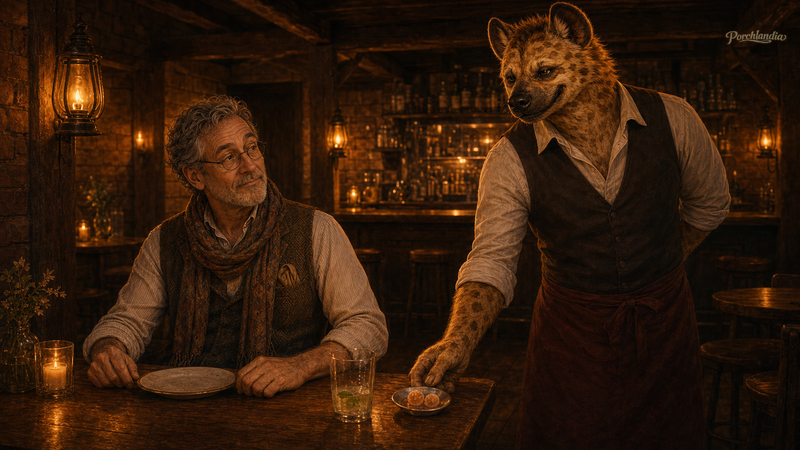
From three rows back, Byron the poet stood. Scarf defying season, vest suggesting strong opinions about the Industrial Revolution.
He did not wait to be called on.
He simply began, his voice ringing out in anapestic tetrameter:
"In the soil of this place where the broken arrive, there's a table, a threshold where souls come alive; not by law or by ledger, by clause or by creed, but by presence, by witness, by noticing need. He has built you a church in the shape of a meal, and the hymnal is laughter, and the offering's real."
Byron bowed once, deeply, and sat.
The room was silent.
Eleanor blinked twice, translating poetry into procedure.
"Thank you for that contribution."
She set her hands flat on the table, the folder closed now in front of her, her shoulders settling into the posture of someone preparing to deliver a verdict she had already written.
"I don't doubt that this place has been meaningful to you. But we don't measure meaning. We measure compliance with HOA bylaws. And Mr. Brooks is not in compliance."
She lifted the gavel. The room felt it before she spoke again: the small weight of a decision crossing from intention into procedure. Brent's hands had stopped shaking only because they had given up.
"I'm prepared to move for immediate cessation of all commercial activity and..."
The door opened.
Senty walked in.
The room didn't just go quiet.
It settled.
Pens stopped mid-stroke. A pencil dropped and rolled across the floor with a sound like distant thunder. Theodore set his paws flat. Percival's tail stilled.
Eleanor's gavel paused above the table.
Senty was wearing his soft glasses, the ones that made him look like an old professor. Denim jacket, worn but clean. His apron folded in one paw, still holding the faint scent of smoked peach wood and cinnamon.
He didn't stomp. Didn't growl.
He walked to the center of the room, steady, deliberate, and stopped three feet from the table.
In the corner, the bison didn't move. He just watched.
Eleanor's mouth opened. Closed. Opened again.
"I'm sorry. You are appearing as a witness?"
"Yes, I am," Senty said.
She set the gavel down very carefully, the wood meeting the table without sound. The whole hearing rearranged itself around the fact that a bear had walked in and meant to speak.
"Please. Proceed."
Senty took a breath, the kind you take before saying something you've been carrying for a long time.
"Thank you. For allowing me to speak."
A pause.
"I want you to know that before this porch, I was a bear who knew how to cook and didn't know where to put it.
"When I asked Brent to help me build this restaurant, I had a vision for what it might be. A place where I could cook. A place where someone could be fed not just at the table but in the conversation around it. I thought I wanted to feel like a chef, to put care into food and smoke and soul, and watch it reach someone across a room.
"It does that.
"But something else is happening that I did not anticipate."
He looked, for a moment, at the back of the room. At Brad in the visor. At Percival with his bowler in his lap. At Theodore. At the bison in the corner who did not look away.
"People are leaving changed from how they were when they walked in.
"Sometimes it's a regular who came in carrying a hard day. Sometimes it's someone I've never seen before and may never see again; they ask to pay their compliments to the chef, and they do, briefly, and then they tell me something else. They tell me what the place did for them that night. That it helped them remember who they were. Or who they would still like to be, in the time they have left.
"A restaurant doesn't do that.
"I don't fully understand what does. I know I didn't build it alone. I know Brent didn't build it alone either. We made room, and something arrived in the room."
He turned to Eleanor. He did not raise his voice. He did not lean forward. He simply held her gaze with the steady kindness of a creature who had seen what the night could do.
"Your codes were written for restaurants. I'm asking you to consider, for a moment, just tonight, whether what we built, whether Smoke and Soul, actually is just a restaurant."
A pause.
"Because Brent made a place where the lonely could be fed, not just with food, but with listening. Where a hyena learned to apologize. Where a cousin found stillness. Where tea became a kind of sacrament.
"He didn't build a restaurant.
"He built a sanctuary."
In the corner, the bison snorted, a brief sound, low and private. He didn't move. No one turned.
The word sanctuary stayed in the room a moment longer than the others had.
Senty waited until it had settled. Then, gently, he turned, not toward Eleanor. Toward Brent in the front row.
"And before you decide what to do with this place, you need to know what kind of man built it.
"He isn't just the one who said yes when I asked him to help me make a restaurant.
"The first night I came to his porch, I was a stranger. I asked if he minded if I sat down."
A beat.
"He didn't just welcome me that night."
A beat.
"He let me stay."
Senty turned back to Eleanor.
"If that violates your codes, then maybe the codes can stretch."
Silence.
The kind that feels like the air before rain.
The room held its breath.
In the back corner, the bison snorted again, sharper this time, barely audible but precise. A scent had been caught, named, and filed somewhere none of them could see.
Then he went still again.
The silence held.
Eleanor looked down at her gavel. At her folder. At Brent.
Her face was unreadable.
Then Brent stood.
His hands were shaking. He didn't speak. He just stood, a man trying to remain upright through having been seen in public by the only voice that could have done it.
Eleanor looked at him for a long moment.
Then one of the other board members, a man who'd been silent the entire hearing, cleared his throat.
"Eleanor," he said quietly. "Maybe we table this. Just for a month. Let them get the permits in order."
Eleanor looked at her folder.
Looked at Senty.
Looked at Brent.
She sighed. The rules had suddenly become smaller than the thing standing in front of her.
"In light of testimony and the board's need for further review, we will reconsider. Mr. Brooks, you have thirty days to submit documentation."
A pause.
"This hearing is adjourned."
The gavel came down.
The room erupted in applause and relieved laughter, the kind that comes when absurdity wins.
In the back corner, during the noise, the bison stood.
He didn't applaud.
He adjusted his sunglasses, turned, and slipped out the side door.
No one noticed.
Except Senty, who glanced toward the exit as it closed.
He didn't say anything.
But somewhere, in the part of him that remembered things he hadn't lived yet, he filed it away.
Brent slumped into his chair.
His hands were still shaking. His eyes were wet.
Senty walked over, glasses sliding down his nose. He adjusted them and sat beside Brent.
For a long moment, neither spoke.
Then Brent whispered, voice cracking:
"You didn't have to do that."
Senty looked at him the way he had the first night on the porch, the way he had every time since.
"I did," he said. "You would've done it for me."
Brent's breath hitched. He looked down at his hands, then up again, the way a man looks when he's been carrying a weight he didn't know was visible.
"I didn't know you saw it that way."
Senty's paw found Brent's shoulder. The contact landed without ceremony: just the weight of a hand that had been there before, was here now, would be here again.
"I see you, Brent. I always have."
Outside, the porch light flicked on.
Not because anyone touched the switch.
Just because it knew.
They walked home together. Not quickly. Not ceremonially. Just two figures on a quiet Texas street, shoulders brushing now and then.
They walked half a block in silence.
A sprinkler ticked somewhere. A neighbor's TV murmured through a screen door. The street kept its own counsel.
Then Brent said, quieter:
"I was scared."
Not what he was scared of. Just the truth of it.
Senty didn't rush to reassure him. No speech. No promise that everything would be okay.
He just said:
"I know."
And they kept walking.
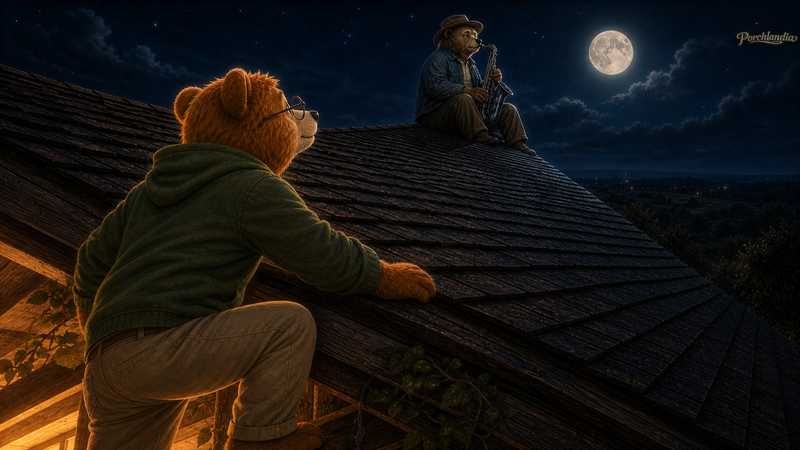
When they reached the porch, Glorp was lighting sparklers in the yard, spinning and whooping. Clement stood on the steps brewing midnight tea. From somewhere (the roof, maybe), a saxophone began to play.
Brent and Senty climbed the steps together.
The boards creaked beneath their weight the way old houses do when recognizing familiar footsteps.
Home.
To a restaurant beneath a porch.
Built from hope.
Defended by love.
And now, improbably, legal.
The tea still steeped.
The porch still glowed.
And somewhere beneath the boards, Smoke and Soul set one more place at the table.