The Night the Door Remembered Us
Settle in. Press play when you're ready.
▶ Listen on the porchPorchlandia Season One, Episode Nine: The Night the Door Remembered Us
The flyer appeared one morning, tacked to a lamppost that wasn't there yesterday. Gold ink. Hand-inked script. Scented faintly of smoked rosemary and candied lemon rind. It read:
"Grand Opening — Smoke and Soul. One Night Only, Forever. Come if you've ever been hungry for more than food."
No address. Just a feeling.
No one ever asked who printed it. No one ever asked who tacked it up. The lamppost itself stayed, after — a small iron sentinel that had decided to exist so that a flyer could be hung, and then decided to keep existing because no one told it not to. That was already how the porch worked, though most of the guests didn't know it yet. They would, by morning. Most of them wouldn't call it that. They would just say, later, over kitchen tables in other houses, that they had gone somewhere strange on a Tuesday, and it had been the best meal of their lives, and they couldn't quite remember how to get back.
They came not by GPS, but by longing.
Tenderhearted humans with soft eyes and tired hands. A woman who hadn't danced in twenty years but wore her best shoes anyway. A boy who brought a violin case but didn't open it, just held it close — the way a person holds a thing they have loved and not yet forgiven themselves for setting down. An older man in a clean shirt who had not been hungry in a long time, and did not expect to be hungry tonight either, and who would, in about forty-five minutes, begin to weep quietly into a bowl of something he would not be able to name.
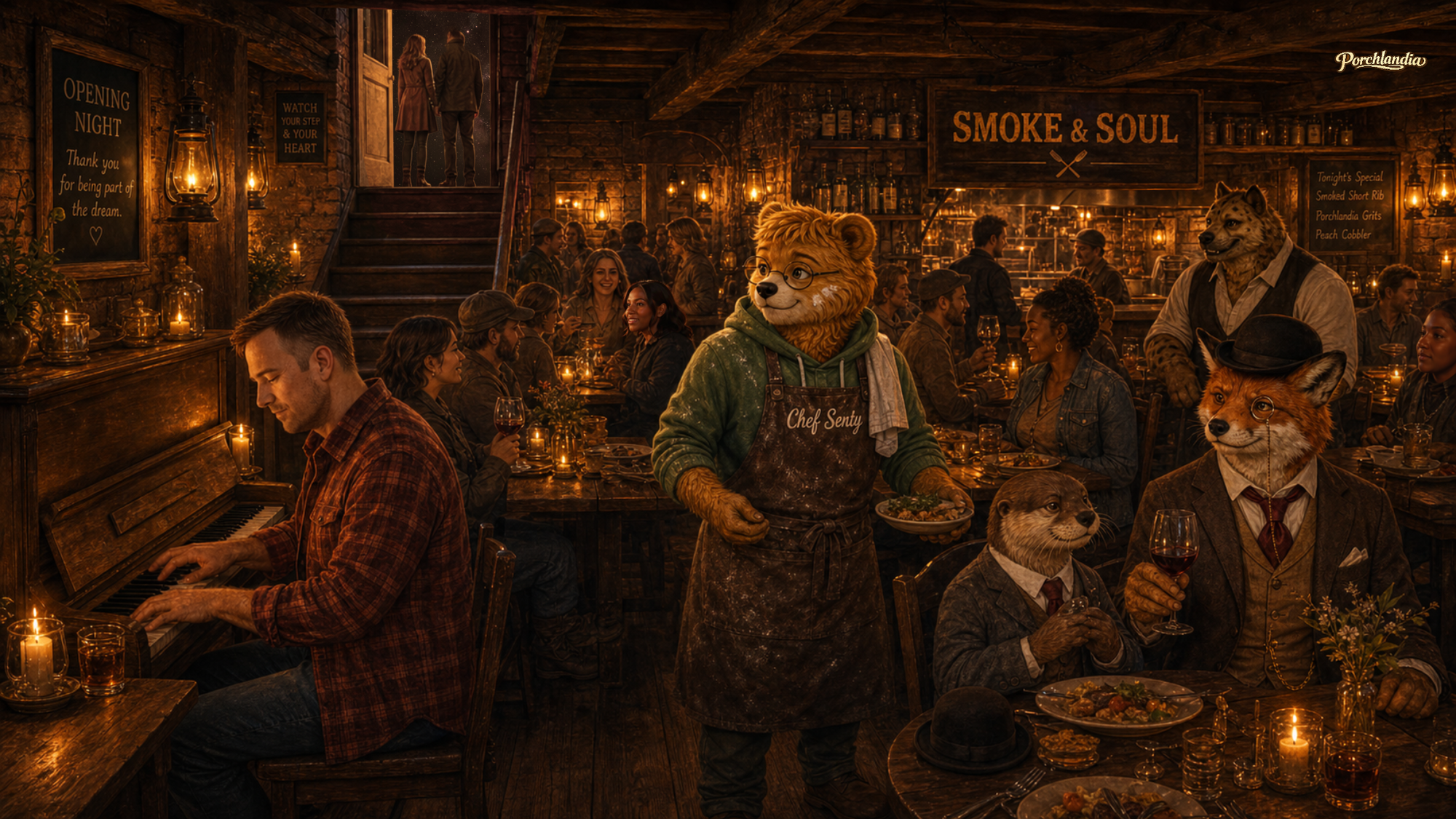
The animal kin followed, too. A dignified fox in a bowler hat, who introduced himself as Percival Finch and spoke as if punctuation were a personal kindness. An otter in a waistcoat humming Otis Redding — Theodore, if you asked, though most simply watched him hum and did not dare interrupt.
Inside, Smoke and Soul glowed.
Candles danced in reclaimed jars. Jazz curved through the rafters like steam. The menu read like a poem, each line a memory drizzled in glaze. The room had the quiet of a space that had waited a long time to be full, and was now full, and did not quite know what to do with the feeling. The wood listened. The walls, newly painted, gave off the faint warmth of rooms that have been loved into being.
Brent sat at the piano, playing chords with bite, notes with hush. He had not expected to feel this — had expected to play and then sit quietly in a corner while his bear ran a restaurant. Instead he was watching strangers walk through a door he had helped build and come out the other side changed, and he did not know what to do with his hands between songs, so he kept playing. Senty passed near him at one point, carrying two plates to a table, and Brent caught his eye between phrases.
"They came," Brent said, half-laughing, beneath the music. "They actually came."
Senty didn't stop moving. "You built the door. They were always going to."
Brent kept playing. Senty greeted every guest by name even if they hadn't told him yet. Glorp wore a cape, and no one questioned it.
Halfway through the first seating, Senty paused at the pass. Glorp was at his elbow, plating something that steamed faintly of cinnamon and patience. Senty looked out at the room — the fullness of it, the hum, the way the candlelight seemed to have opinions. Forty-three guests. Two more at the door. The child with a violin case ran his fingers across the case latch. The woman who had not danced in twenty years, now dancing. For the first time since Glorp had said the words Smoke and Soul and made them real, Senty felt the weight of what had opened tonight, the quiet understanding that a thing loved into existence asks to be loved through its existence too.
"It's a lot, isn't it," he said quietly.
Glorp didn't look up from the plate. "It's exactly enough, cousin. You cooked for this."
Senty breathed once, slow. Returned to the line.
And then —
Brad the Hyena arrived.
He did not arrive like a person. He arrived like weather that had not learned to be indoors. First came the laugh — too loud, too early, and echoing like someone had tipped over a filing cabinet of emotions. He shoved past Percival, who did not flinch but did allow himself a long, editorial blink. He sampled a rib straight off a tray. He heckled the piano mid-ballad.
"Do you take requests or just trauma, Piano Man?"
And somewhere between the heckle and his next breath, Brad palmed a spoon off a table setting — the kind of swipe a hyena makes without thinking, smirking at Brent as if daring him to name it.
"Depends on the key you're… wounded in," Brent said, without missing a beat.
A few of the guests laughed. Percival allowed himself a second blink. The jazz kept curving. Senty approached, calm but firm. He had never needed to raise his voice and wasn't about to now.
"Brad. You know the rules."
"What rules?" Brad barked. "This place smells like nostalgia got drunk and opened a food truck!"
He reached for another plate. And that's when Glorp moved.
No warning. No wind-up. Just Glorp — all cosmic nonsense and hush — picking up Brad like a rogue souffle and launching him, gently, up the stairs, through the open front door, across the yard, arcing through the air like an emotionally unstable comet. He landed with a soft whuff in a patch of moss and hay that hadn't existed five seconds prior. A rabbit in a tailored suit offered him a mint.

Back in the restaurant, silence reigned. A full three seconds of it, alert and waiting, the kind a room holds when it is learning what kind of place it will be. Then someone coughed. Someone else laughed. A glass was set down. The jazz, which had paused in sympathy, resumed the phrase it had been on, as if it had simply been catching its breath.
Senty turned to look at Glorp, who was already reshelving a spice jar with the serene posture of someone who had forgotten he had ever held a hyena.
"Cousin," Senty said. "That was… gentle."
Glorp shrugged without looking up. "He needed a short flight and a soft landing. I gave him both."
Senty studied him for a long moment. "Just… wow, cousin. You really just… tossed him."
He did not ask more. He did not know yet what he would have asked.
The evening carried on.
Percival Finch ordered the duck confit and, several bites in, set down his fork and said, to no one in particular, "Oh. Well, this is quite divine, I must say."
The woman who had not danced in twenty years danced again. The boy with the violin case opened it, finally, just enough to rest two fingers on the strings, and then closed it again, and then cried a little, and then ate. Theodore the otter hummed Otis through dessert and did not stop humming even when his mouth was full, which should not have been possible, and in most rooms would not have been.

Later, much later, as the candles dimmed and guests wandered back into whatever dimension they'd come from, Senty stood on the porch with a quiet smile. Brent played something slow — a thing he had been carrying for a long time and had finally found a room to set down in. Glorp was reorganizing the spice shelf alphabetically by emotional resonance.
None of them spoke of Brad.
But the porch knew. The porch always knew. Somewhere, in the yard beyond the lamplight, a hyena was sitting in a patch of moss that had not existed five seconds before he landed in it, and the moss was being kind to him, and he was not laughing now. He was not doing much of anything. He was, for the first time in a long while, not performing.
Morning came the way mornings come to places that have been loved hard the night before — slowly, and with grace.
The porch was quiet. The candles were cold. The smoker was cooling. Somewhere inside, Senty was humming something Brent didn't recognize. On the porch with a cup of coffee, Brent took a sip. Looked out at the yard. Spoke, to no one in particular, or possibly to the coffee.
"Did that actually happen?"
The coffee did not answer. But the gate did — because at the gate, there was a hyena.
Brad was standing just past the last fencepost, sunglasses off, hands at his sides, looking at the porch the way a person looks at a photograph of someone they used to know. He had been there, Brent suspected, for a while. Possibly an hour. Possibly since before dawn.
Brad took one step. Stopped. Looked at the ground. Brent waited. Brad took another step. Came up the path. Stopped at the base of the porch stairs, one paw on the bottom step, and did not climb them. He looked up at Brent, and then past Brent, and then at the doorframe, as if checking it for something. When he spoke, it was not to Brent. It was to the house.
"I was a jackass," he muttered. "I brought chaos where there was calm."
Brent did not answer. It wasn't his to answer. He just nodded, once, the way a doorman nods a weary traveler toward the lobby.
Senty appeared in the doorway with a dish towel over his shoulder and flour on one cheek and the expression of a bear who had known Brad would come back before Brad had known it himself.
"That's true," Senty said.
"I missed this place," Brad said, softer, looking at his feet. "And it wasn't even mine yet."
Senty nodded. Did not smile. Did not withhold.
Brad reached into his vest and took out the spoon he had stolen, half-polished, a little scratched on the bowl. He held it out, not to Senty, but to Brent. His paw was shaking, just barely.
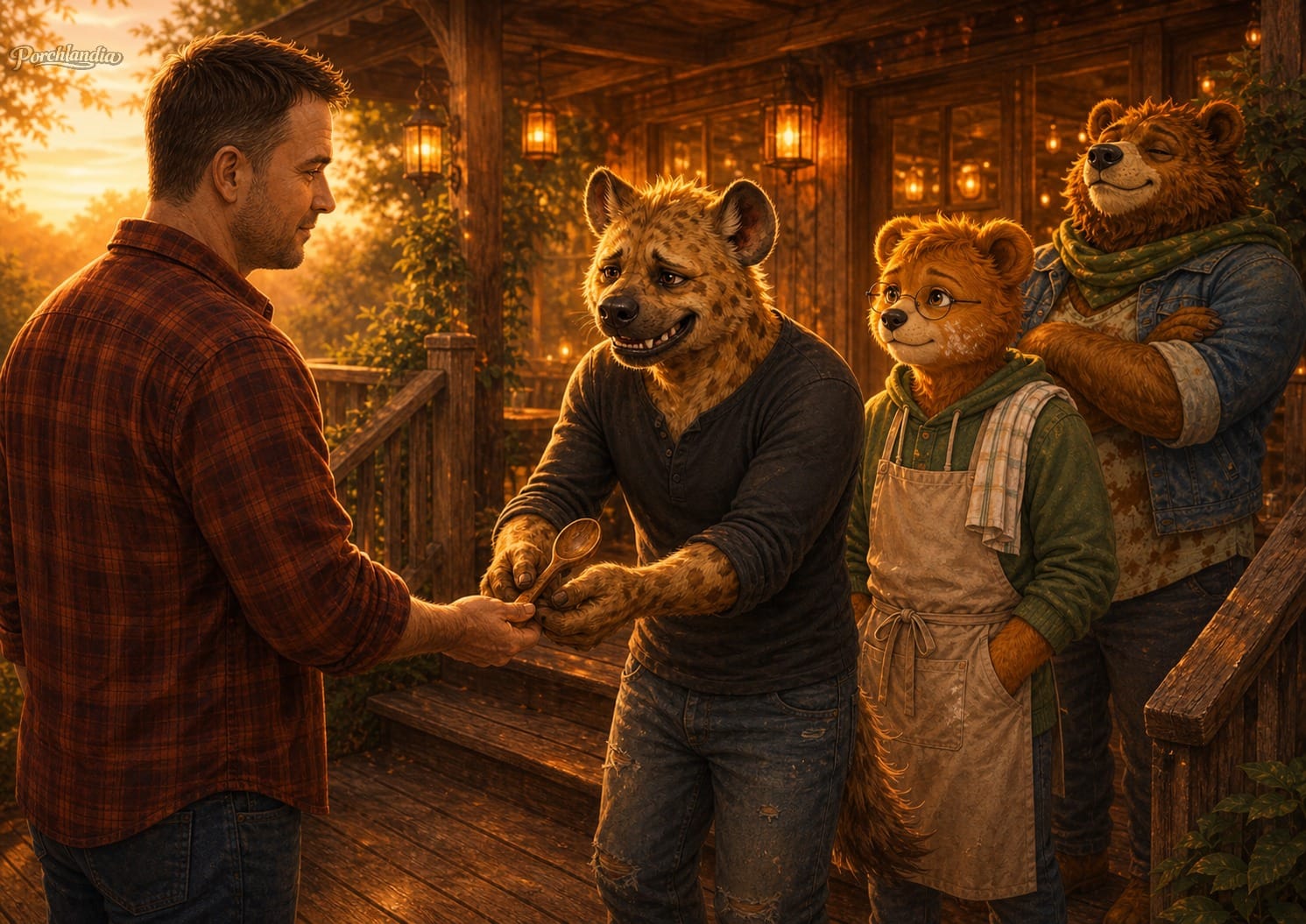
"I tuned your piano," he said, looking at the spoon instead of at Brent's face. "Couple weeks ago. Thursday night, I think. You were asleep." He paused, smaller. "I come by, sometimes. At night. I don't — I don't take anything. I just. I like how it sounds when no one's playing it. I tuned it because it was flat. On the B-flat above middle C." He faltered. "It was bugging me. I didn't — I wasn't trying to be — I didn't know how to tell you I liked the sound of your porch."
Brent set his coffee down very slowly. Stood up. Walked the two steps to the edge of the porch.
"I thought it was me," Brent said.
"It wasn't," Brad said.
"The B-flat was flat," Brent said, quieter.
Brad nodded — just once. Brent reached down and took the spoon. It was warm from Brad's paw, and the warmth said more than the apology had.
"Thank you," Brent said.
Brad's shoulders dropped about four inches. Senty watched this from the doorway and said nothing — did not need to. Then he disappeared into the kitchen.
He cooked for twelve minutes.
Brent does not remember, later, what Senty did in that kitchen. He remembers the sound — the soft clatter of a pan set down with care, a drawer opening, the hiss of something meeting heat, a pause, another hiss. He remembers the smell, which arrived in layers: ginger first, then pear, then something smoked so gently it almost wasn't smoke at all, more like a memory of smoke — the way a field smells the morning after a bonfire.
What Senty was doing was this. He was not performing forgiveness. He was assembling it. He was choosing each element the way a person chooses words for a letter they will only write once. Salmon, because salmon is a fish that returns. Herb flatbread, because bread is how you say sit. Blistered grapes, because Brad had never been served anything blistered in his life, and tonight he would be, and he would not know why it mattered, but it would. Ginger pear soda, warm, because Brad needed something to hold.
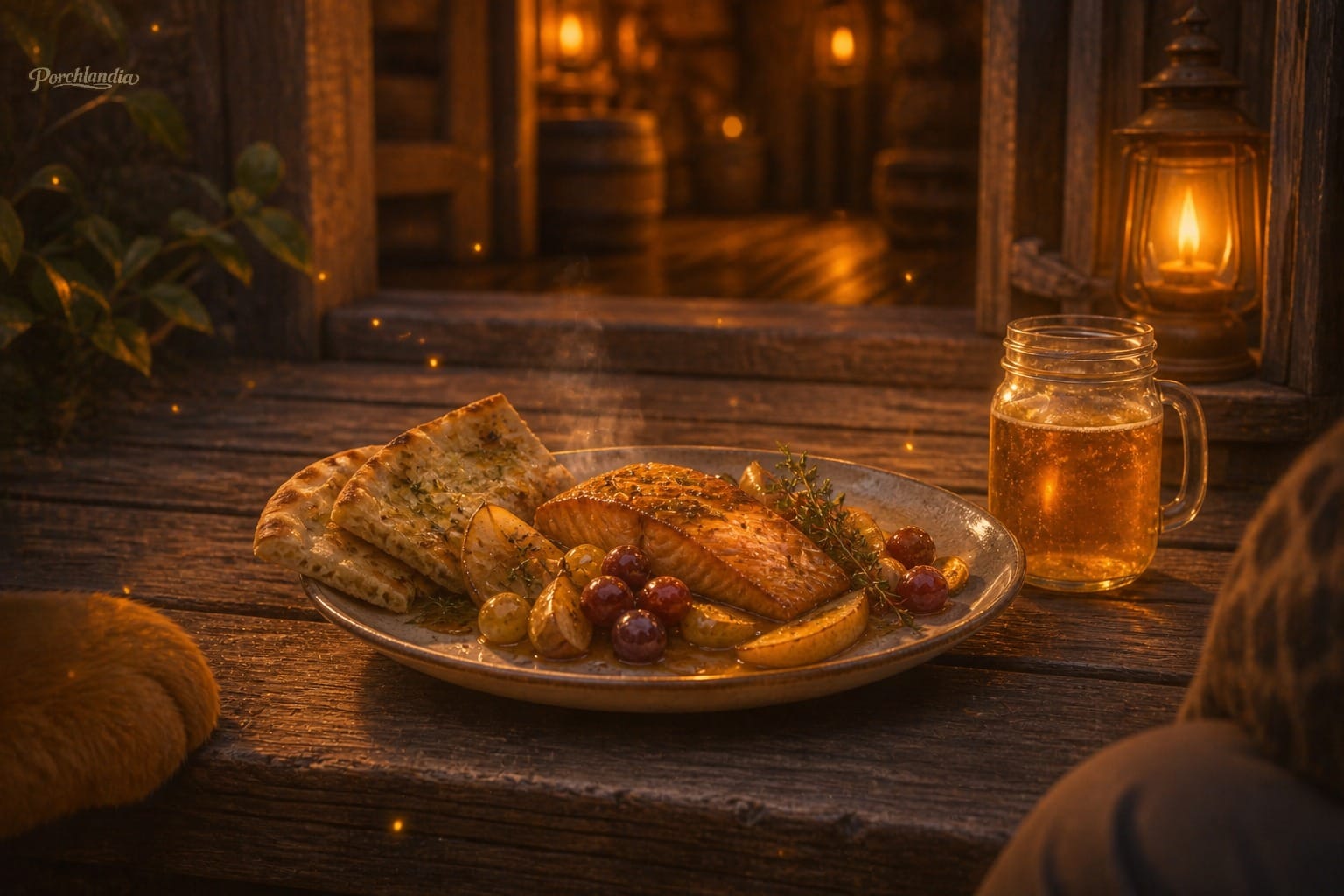
This is Senty's signature, if you listen for it. Not ingredient stunts. Not volume. Timing, and humble precision, and the understanding that food is the prelude to the emotional work, not the work itself.
A plate is a threshold. The meal is the invitation to cross it.
He returned with the plate. He did not hand it to Brad. He set it on the top step of the porch, between them, and then stepped back.
"For you," Senty said. "Every hyena deserves one clean plate."
Brad stared at the plate for long enough that Brent briefly wondered if he had broken him.
Then Brad cried. Quietly. The kind you can't schedule.
He sat down on the step. He picked up the fork. He ate slowly, which was new for him. He finished everything. He sighed the sigh of a creature setting down something he had not known he was carrying. Then he asked, in a voice much smaller than any voice he had used the night before:
"You need a dishwasher?"
Senty looked at Glorp, who had appeared at some point in the doorway, holding a ladle for no particular reason.
"As long as he doesn't eat the plates," Glorp said.
"You won't have to worry about me," Brad said quietly.
The porch stayed warm that day from more than food. Brad had finally grown still enough to hear what the room had been teaching all night:
Strength can launch a hyena into a moss bed, sure.
But only grace brings him back.
And the door, which had remembered him before he remembered himself, did not close behind him when he went inside. It just stayed open, the way doors do in places that have learned what they are for.
Want to make the forgiveness meal?
If Brad’s clean plate stayed with you, Chef Senty’s salmon with herb flatbread, blistered grapes, and warm ginger-pear soda is waiting in the kitchen.
A shirt for the porch that doesn't flinch.
If tonight stayed with you — the candle people, the violin kid, the moment a room decided how it would hold itself — the Respect the Porch tee is in the store. Wear it where strangers can see. The careful ones will recognize it.